
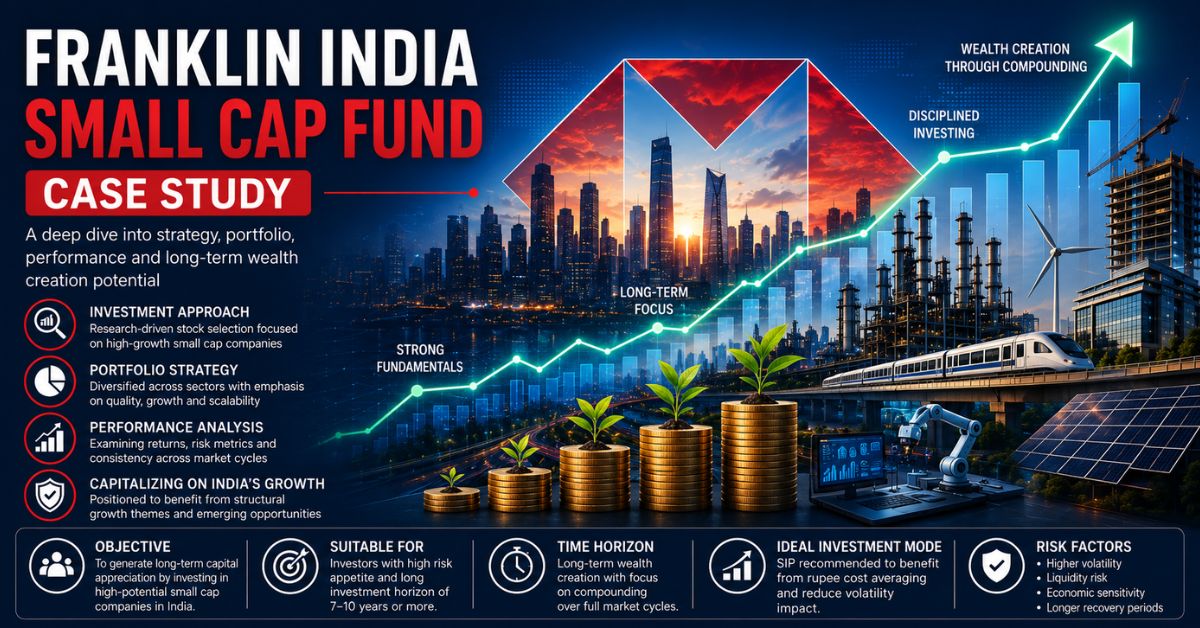
Category: Mutual Fund Case Study
Written by: Vittarthi Research Desk | Dedicated to analysing mutual funds, stocks, ETFs, and market trends through data-driven research and publicly available financial disclosures.
Reviewed by: Vittarthi Editorial Team | Factual accuracy using official fund house documents, AMFI disclosures, SEBI guidelines, portfolio reports, and historical performance data available in the public domain.
This case study covers: Part 1: Executive Summary, Investment Philosophy & Market Context | Part 2: Portfolio Construction, Sector Allocation & Institutional Analysis | Part 3: Performance, SIP Returns, Scenarios & Final Verdict | FAQs
Part 1: Executive Summary & Investment Framework
Franklin India Small Cap Fund occupies a distinctive position within India's small-cap mutual fund universe. While many small-cap funds focus primarily on momentum-driven growth, Franklin Templeton's investment philosophy has historically leaned toward disciplined fundamental research, valuation awareness, and long-term business ownership — a GARP (Growth at Reasonable Price) approach that prioritises the quality and sustainability of earnings over headline growth rates.
The fund seeks to identify emerging businesses before they become mainstream market leaders. Many of India's most successful companies — Avenue Supermarts, Page Industries, Astral Limited, Titan Company — began as relatively unknown small-cap businesses before evolving into large-cap wealth creators. Franklin India Small Cap Fund attempts to identify the next generation of such compounders through deep fundamental research and disciplined stock selection, before their growth potential is fully recognised by the market.
Fund Context (as of 2026): Franklin India Small Cap Fund is managed by Franklin Templeton Asset Management (India) Pvt. Ltd., a subsidiary of Franklin Templeton Investments — one of the world's largest independent asset management companies with over 75 years of global investment experience. The fund is benchmarked against the Nifty Smallcap 250 TRI and follows a bottom-up, research-intensive stock selection framework. As India's economy continues expanding across manufacturing, infrastructure, consumption, and financial services, the fund aims to capture opportunities in businesses that can scale significantly over 7–15 year investment horizons (Franklin Templeton MF Factsheets, AMFI data).
Key Findings at a Glance:
- GARP and quality-first philosophy differentiates it from purely momentum-driven small-cap strategies.
- Emphasis on valuation discipline — buying quality businesses at reasonable prices, not just chasing growth.
- Diversified portfolio across 7+ sectors reduces single-business and single-sector concentration risk.
- Small-cap category drawdowns of 40–55% during crisis periods are expected and normal — this fund is no exception.
- Requires a minimum 7–10 year investment horizon; returns over shorter periods are highly unpredictable.
Core Conclusion: Franklin India Small Cap Fund is built for patient, long-term investors. Its real value is in helping disciplined investors participate in India's emerging businesses through a valuation-aware, quality-focused framework over 7 to 15 years or longer — not for short-term return chasing.
Key Fund Snapshot
| Parameter | Details |
|---|---|
| Fund Name | Franklin India Small Cap Fund |
| Category | Small Cap Fund (SEBI mandated: min. 65% in small-cap stocks) |
| Fund Type | Open Ended Equity Scheme |
| Benchmark | Nifty Smallcap 250 TRI |
| Investment Style | Growth at Reasonable Price (GARP) + Quality Investing |
| Risk Level (SEBI Riskometer) | Very High |
| Recommended Horizon | 7+ Years (ideally 10–15 years) |
| SIP Suitability | High — rupee-cost averaging well suited to small-cap volatility |
| Suitable Investor Type | Aggressive long-term investors with high volatility tolerance |
India's Structural Growth Drivers in 2026: Why Small Caps Matter
India's economic landscape in 2026 remains fundamentally supportive for small-cap companies. Several structural drivers are creating long-term opportunities for emerging businesses across multiple industries. India's GDP grew at approximately 6.5–7% in FY2025 (IMF World Economic Outlook, 2025), the government's capital expenditure budget crossed ₹11 lakh crore in FY2025, and monthly SIP inflows crossed ₹26,000 crore in late 2024 — deepening domestic equity participation that provides structural support to small and mid-cap segments (AMFI, 2024).
India Growth Themes Supporting Small Caps — Outlook Strength
Source: Research synthesis based on Ministry of Finance, AMFI, IMF WEO 2025, and Chemicals Export Promotion Council data
Why Small Caps Generate Superior Long-Term Returns — and Higher Risk
Historically, small-cap companies have delivered some of the highest long-term returns in equity markets. The primary reason is their ability to grow earnings at a faster pace than mature large-cap businesses — often at 20–30% CAGR during high-growth phases vs. 10–15% for established large-caps. However, this higher growth comes with structurally elevated volatility, lower liquidity, greater governance risk, and sharper drawdowns during economic stress periods. Professional fund management becomes especially critical in this environment.
Small Cap vs. Large Cap: Risk & Return Trade-off
Return Potential
Volatility / Risk
Higher return potential in small caps is inseparable from higher volatility — both are structural features of the asset class
Investment Philosophy: What Makes Franklin Templeton's Approach Different
Franklin Templeton has historically emphasized fundamental investing and valuation discipline — two qualities that are genuinely scarce among small-cap fund managers who often drift toward momentum or thematic investing during bull phases. Rather than asking "which company is growing fastest right now?", the investment process consistently asks a deeper question: Is this business available at a valuation that provides an adequate margin of safety against the risks being taken?
Business Quality: Can the company sustain growth over multiple economic cycles? Businesses without durable competitive advantages lose earnings momentum the moment a competitor or industry disruption arrives — especially visible in smaller, less diversified businesses.
Management Quality: Does management allocate capital efficiently and with shareholder alignment? In small-cap investing, management quality is a primary risk factor — poor capital allocation decisions compound negatively just as effectively as good ones compound positively.
Financial Strength: Can the company withstand adverse economic conditions? The fund strongly prefers businesses with low debt-to-equity ratios because small-cap companies with high leverage are disproportionately vulnerable to interest rate increases and credit tightening — temporary business slowdowns can become permanent impairments when balance sheets are weak.
Valuation Discipline: Can the business generate attractive returns from the current entry price? Excellent businesses can still be poor investments if purchased at excessive valuations — a lesson many investors learn painfully during P/E contraction cycles.
Core Investment Decision Drivers — Importance Weight
Institutional evaluation framework — weighting reflects decision-making priority, not predicted outcome
Coming Up in Part 2: Portfolio construction framework, sector allocation analysis, market cap breakdown, diversification methodology, FII and DII perspectives, and how risk is managed at the portfolio level.
Part 2: Portfolio Analysis, Sector Allocation & Institutional Perspective
A mutual fund's future performance is ultimately determined by the quality of businesses it owns, the sectors it favours, the risks it takes, and the valuations it pays. Professional investors spend far more time analysing portfolios than analysing historical returns — because past returns explain what happened, while portfolio quality helps estimate what may happen next.
Portfolio Construction: Five-Pillar Evaluation Framework
| Evaluation Pillar | Focus Area | Why It Matters |
|---|---|---|
| Business Model | Scalability and durability of competitive advantage | Reduces probability of permanent capital loss |
| Management Quality | Governance standards and capital allocation history | Ensures shareholder-aligned decision making |
| Financial Strength | Debt levels, cash flow generation, ROCE, ROE | Confirms quality is backed by hard numbers |
| Industry Structure | Competitive positioning and long-term demand visibility | Ensures sector tailwinds support earnings growth |
| Valuation | Margin of safety and upside potential at entry price | Ensures attractive risk-reward before capital is committed |
Why Portfolio Construction Matters More During Downturns: Two small-cap funds may generate similar returns during a strong bull market. However, during difficult periods — credit crises, global recessions, liquidity shocks — business quality becomes critical. Companies with strong balance sheets can absorb external shocks that permanently impair leveraged competitors. This is why institutional investors place greater emphasis on portfolio construction quality than on short-term trailing returns: a process built on strong fundamentals is more likely to deliver consistent outcomes across the full economic cycle.
Sector Allocation: Where the Strategic Opportunity Lies
Franklin India Small Cap Fund historically maintains broad diversification across sectors that benefit from India's long-term structural growth story. Sector allocation reveals where the fund manager sees durable multi-year growth opportunities — not just near-term cyclical momentum.
Sector Strategic Importance Framework
Note: Actual sector allocations change periodically. Refer to Franklin Templeton's latest monthly factsheet for current data.
Market Capitalisation Framework
| Market Cap Segment | Portfolio Role | Strategic Purpose |
|---|---|---|
| Small Cap (65%+ minimum) | Primary Growth Driver | Core mandate — where the alpha generation thesis lives |
| Mid Cap (selective) | Stability Layer | Graduated holdings — businesses that have outgrown small-cap but still have growth runway |
| Cash & Equivalents | Liquidity Buffer | Manages redemptions, enables opportunistic deployment during corrections |
Diversification: The Primary Risk Control in Small-Cap Investing
When investors evaluate a small-cap fund, diversification is often treated as a secondary consideration. For this asset class specifically, it is the primary risk management tool — the difference between recoverable volatility and permanent capital loss. Research by Evans and Archer (1968) found that diversification benefits are especially pronounced in small-cap portfolios because individual small-cap companies carry significantly higher idiosyncratic volatility than large-caps.
Number of Holdings vs. Company-Specific Risk
Source: Evans & Archer (1968) — marginal diversification benefit analysis. Risk diminishes significantly beyond 30–40 uncorrelated positions.
Four dimensions of effective diversification for small-cap investors:
- Within small caps — use a fund, not direct stocks: Owning 3–5 individual small-cap stocks creates extreme concentration risk. A single bad outcome — promoter fraud, SEBI investigation, or sudden business disruption — can permanently impair 20–33% of your small-cap capital. A fund's 40–100+ holdings limit this to 1–2% per event.
- Small caps within your overall equity portfolio: Cap small-cap mutual funds at 20–30% of total equity exposure, balanced by large-cap or flexicap funds that provide stability during small-cap bear phases.
- Across asset classes: During the COVID crash of March 2020, the Nifty Smallcap Index fell approximately 47% in 45 trading days. Investors who also held gold or short-duration debt funds experienced significantly less stress — and maintained the emotional composure to stay invested through the recovery.
- Annual rebalancing: After the 2021–2024 small-cap bull run, many investors' allocations drifted well above target. Rebalancing enforces the discipline of selling high and buying low systematically — without requiring any market timing skill.
How Institutional Investors Evaluate Small-Cap Funds
Institutional Evaluation Priority Score (out of 10)
Process sustainability is prioritised over short-term performance rankings
What FIIs and DIIs Are Watching in 2026
| Theme | FII Importance | DII / Domestic Impact |
|---|---|---|
| Manufacturing Growth | Very High | Very High |
| Export Competitiveness | High | Moderate |
| Earnings Expansion | Very High | Very High |
| Corporate Governance | Very High | High |
| SIP Flow Strength | Moderate | Very High — primary price support |
| Currency Stability | High | Moderate |
Risk Assessment Matrix
| Risk Category | Impact | Probability | Mitigation |
|---|---|---|---|
| Market Correction | High | High | Long horizon, SIP investing |
| Liquidity Stress | High | Moderate | Liquidity screening in portfolio construction |
| Earnings Slowdown | Moderate | Moderate | Diversification across sectors |
| Governance Failure | High | Low–Moderate | Management quality filter, position sizing |
| Valuation Compression | High | Moderate (2026 context) | GARP discipline, valuation checks before entry |
Coming Up in Part 3: Historical performance across market cycles, SIP wealth creation illustrations, bull/base/bear scenario analysis, peer comparison, investor suitability framework, and the final verdict.
Part 3: Performance Analysis, SIP Returns, Scenarios & Investor Verdict
The ultimate objective of small-cap investing is not to outperform every year but to generate superior long-term wealth creation through earnings compounding across full market cycles. Institutional investors evaluate performance using a much broader framework — long-term consistency, risk-adjusted returns, portfolio quality, downside resilience, and earnings growth sustainability — not just trailing 1-year or 3-year numbers.
Performance Across Historical Market Cycles
| Period | Market Event | Small Cap Impact | Investor Experience |
|---|---|---|---|
| 2008–09 | Global Financial Crisis | Severe Correction — 60%+ decline | Extreme stress; SIP investors accumulated units cheaply |
| 2010–14 | Economic Recovery | Strong Recovery Gains | Significant wealth creation for patient investors |
| 2016–18 | Domestic Growth Cycle | Outperformance vs. large caps | Strong returns across most portfolios |
| 2020 | COVID Market Crash | ~47% decline in 45 trading days | Full recovery within 6–9 months for those who stayed invested |
| 2020–21 | Liquidity-Led Rally | Exceptional Performance | New all-time highs; accelerated compounding |
| 2022 | Global Rate Tightening | Increased Volatility | Flat to negative short-term returns |
| 2023–25 | Economic Recovery | Positive Trend | Compounding accelerated for long-term holders |
The Key Lesson from Market History: Investors who maintained SIPs through the 2020 COVID crash saw their average purchase cost fall dramatically as NAVs dropped — and benefited disproportionately from the subsequent recovery. Investors who panic-sold at the lows locked in permanent losses on declines that proved entirely temporary. History consistently shows that the greatest risk in small-cap investing is not market volatility itself — it is the behavioural response to that volatility.
SIP Wealth Creation: Illustrative Projections at 12% Annualised Return
| Monthly SIP | 10 Years | 15 Years | 20 Years |
|---|---|---|---|
| ₹5,000 | ₹13.8 Lakh | ₹30.3 Lakh | ₹65.9 Lakh |
| ₹10,000 | ₹27.6 Lakh | ₹60.6 Lakh | ₹1.31 Crore |
| ₹20,000 | ₹55.2 Lakh | ₹1.21 Crore | ₹2.63 Crore |
| ₹30,000 | ₹82.8 Lakh | ₹1.82 Crore | ₹3.95 Crore |
Illustrative assumption: 12% annualised return calculated using XIRR methodology. Actual returns will differ. This table shows the mathematical power of compounding — not a performance guarantee.
The Power of Compounding: ₹15,000/month SIP over 15 Years at 12%
Total invested: ₹27,00,000 → Potential corpus: ₹90,90,000+ → Wealth generated: ₹63,90,000+
Invested:
₹1.8L
Invested:
₹5.4L
Invested:
₹9L
Invested:
₹14.4L
Invested:
₹27L
Illustrative at 12% CAGR. Actual returns vary. Compounding accelerates sharply after year 8 as reinvested gains outpace new contributions.
Why Rolling Returns Matter More Than Trailing Returns
| Rolling Return Observation | What It Reveals |
|---|---|
| Stable rolling returns over 5–7 years | Strong, repeatable investment process |
| High return dispersion across periods | Elevated volatility; cyclical dependency |
| Consistent outperformance vs. benchmark | Sustainable alpha generation edge |
| Frequent underperformance phases | Potential process or style concern |
Forward Scenarios: 2026–2031
| Scenario | Probability | Key Conditions | Expected Outcome |
|---|---|---|---|
| Bull Case | Moderate | Strong GDP growth, manufacturing boom, earnings upgrades, stable inflation | Significant small-cap outperformance; strong alpha generation |
| Base Case | High | Moderate economic growth, stable earnings expansion, continued SIP inflows | Consistent long-term wealth creation; 1–2 correction phases within period |
| Bear Case | Moderate | Global recession, earnings downgrades, liquidity tightening | Elevated volatility; possible negative 3-year returns; extended recovery |
Peer Comparison: Franklin India vs. Typical Small-Cap Fund
| Parameter | Franklin India Small Cap | Typical Small Cap Fund |
|---|---|---|
| Valuation Discipline | Strong — GARP framework | Moderate — varies by fund |
| Research Intensity | Strong — bottom-up process | Moderate |
| Diversification | High — broad sector spread | Moderate |
| Risk Management | Strong | Variable |
| Growth Orientation | High | High |
| Long-Term Potential | Strong | Moderate to Strong |
What Institutional Money Is Watching in 2026 — Importance Score (out of 10)
Who Should Invest — and Who Should Not
| Investor Profile | Suitability | Reason |
|---|---|---|
| Long-term SIP investor (7–10 yr+) | ✅ Suitable | Compounding and rupee-cost averaging work strongly in their favour |
| Young investors (25–35 years) | ✅ Suitable | Long time horizon absorbs volatility; career income sustains SIPs |
| Aggressive growth seekers | ✅ Suitable | As a 15–25% component of equity — not the sole equity holding |
| Conservative or retired investors | ❌ Not Suitable | Cannot afford 40–55% NAV drawdowns; need capital preservation |
| Short-term investors (<3 years) | ❌ Not Suitable | High probability of negative returns in any 1–2 year window during downturns |
| Income-seeking investors | ❌ Not Suitable | Returns are entirely capital appreciation; no dividends; highly volatile |
Vittarthi Research Rating
| Parameter | Rating |
|---|---|
| Portfolio Quality | ★★★★★ |
| Research Framework | ★★★★★ |
| Diversification | ★★★★★ |
| Risk Management | ★★★★☆ |
| SIP Suitability | ★★★★★ |
| Long-Term Potential | ★★★★★ |
| Overall Assessment | ★★★★★ |
Action Plan for Retail Investors
Step 1 — Define Your Horizon First: Invest only money you are genuinely comfortable leaving untouched for 7–10 years. Emergency funds have no place here. Ensure 6 months of expenses sit in a liquid fund before committing any capital to small-cap equity.
Step 2 — Honestly Assess Volatility Tolerance: Can you watch your portfolio fall 40% and continue your SIP without selling? If not, build emotional resilience with a large-cap or flexicap fund through at least one 15–20% correction first — before allocating to small caps.
Step 3 — Prefer SIP Over Lump Sum: A fixed monthly SIP you can sustain even during bad markets. Automation removes emotional decisions. Consistency beats timing — especially in volatile asset classes like small caps.
Step 4 — Cap Allocation at 20–25% of Total Equity: Balance with large-cap funds, flexicap funds, and debt instruments. No single theme should dominate a portfolio. Calculate your true small-cap exposure including all assets and accounts.
Step 5 — Continue Investing During Corrections: Market corrections are when rupee-cost averaging works hardest in your favour. Pausing SIPs during downturns eliminates the most powerful benefit of the strategy.
Step 6 — Review Annually, Not Daily: Check quarterly fund factsheets for earnings growth trends in underlying holdings. Judge the fund on whether businesses are growing — not whether NAV moved this week. Annual reviews are sufficient; daily monitoring actively hurts decision quality.
Final Verdict
Franklin India Small Cap Fund stands out as a disciplined, research-driven, and valuation-aware small-cap strategy. Its GARP and quality-focused investment philosophy, broad sector diversification, emphasis on balance sheet strength, and institutional-style evaluation framework position it as a vehicle designed to generate sustainable long-term wealth — rather than chase momentum during speculative rallies.
The fund may not always lead performance rankings during speculative bull phases — which is precisely why its long-term outcomes tend to be more consistent. Valuation discipline often means leaving short-term returns on the table in exchange for better downside protection and more sustainable compounding across the full economic cycle. Investors who enter with realistic expectations, adequate time horizon, and genuine understanding of small-cap volatility are well served by this investment philosophy.
Following the exceptional 2021–2024 small-cap rally, near-term return expectations should be moderated — valuations have expanded significantly, and mean reversion through P/E compression is a real risk even when underlying businesses continue growing earnings. This makes valuation-aware funds like Franklin India Small Cap particularly relevant for new investors in the current environment.
Wealth is not created by predicting short-term market movements. It is created by staying invested in quality opportunities long enough for compounding to work — and by maintaining a diversified portfolio that ensures no single outcome can permanently derail the journey.
Explore More on Vittarthi
How Does Franklin India Small Cap Compare with the Best Small Cap Funds ?
See how Franklin stacks up against SBI, DSP, Nippon, HDFC, and Quant — with data-backed analysis across returns, drawdowns, and portfolio quality to help you choose the right fund for your goals.
Compare Best Small Cap Mutual Funds →Frequently Asked Questions
Q1. What is Franklin India Small Cap Fund and who manages it?
Franklin India Small Cap Fund is an open-ended equity mutual fund managed by Franklin Templeton Asset Management (India) Pvt. Ltd. — a subsidiary of Franklin Templeton Investments, one of the world's largest independent asset management companies with over 75 years of global investment experience. The fund is benchmarked against the Nifty Smallcap 250 TRI and follows a GARP (Growth at Reasonable Price) and quality-focused investment philosophy. It primarily invests in companies ranked 251st and below by market capitalisation on Indian exchanges, as defined by SEBI's categorisation circular, targeting businesses with strong earnings growth potential, quality management, sound balance sheets, and reasonable entry valuations.
Q2. Is Franklin India Small Cap Fund suitable for beginners?
Accessible in terms of minimum SIP amounts, but demanding in terms of emotional discipline. Beginners who have not previously experienced a 40–50% portfolio decline are statistically more likely to panic-sell at the worst possible moment, converting temporary paper losses into permanent capital losses. The practical approach for beginners is to first build emotional resilience by holding a large-cap or flexicap fund through at least one significant 15–20% correction, then add a small-cap fund once you have real lived experience of staying invested during market stress. Also ensure 6 months of expenses remain in a liquid fund before committing any capital here.
Q3. What investment style does the fund follow?
Franklin India Small Cap Fund broadly follows a GARP (Growth at Reasonable Price) and quality-focused investment approach — sitting between pure growth investing (which prioritises the highest growth regardless of valuation) and pure value investing (which prioritises cheapness regardless of growth quality). The framework asks both "Is this business growing earnings strongly?" and "Is it available at a reasonable valuation that provides a margin of safety?" simultaneously. This dual filter tends to produce a portfolio of businesses that may not top short-term momentum rankings but that deliver more consistent outcomes across complete economic cycles.
Q4. What is the ideal investment horizon?
A minimum of 7 years, with 10–15 years being optimal. Small-cap returns are distributed very unevenly over time — in any single year, NAV could range from strongly positive to deeply negative. Over 3 years, negative outcomes remain possible if you entered at a market peak. Over 7+ years, the probability of a negative real-return outcome has historically been very low for well-managed small-cap funds, because underlying business earnings growth eventually overwhelms valuation cycle noise. Investors who entered Franklin India Small Cap Fund during the 2008 crisis, 2018 bear phase, or 2020 COVID crash — and stayed invested — all achieved strong long-term outcomes. Those who exited at market lows did not.
Q5. Is SIP recommended over lump sum?
For most retail investors, SIPs are significantly better suited for small-cap funds. The mechanism is rupee-cost averaging: when NAV falls during corrections, each SIP instalment automatically buys more units at lower prices, reducing average cost without requiring any decision. Research on SIP outcomes in Indian small-cap funds consistently shows that investors who maintained SIPs through bear phases achieved meaningfully better long-term outcomes than those who paused or stopped. Lump-sum investing can outperform when deployed after 35–40%+ market declines from peak — but this requires both analytical conviction and the emotional courage to act when every headline is negative, which most investors cannot reliably execute in practice.
Q6. What are the key risks investors must understand?
Five risks are structurally unavoidable in small-cap investing. Market risk: small-cap stocks can experience 40–55% drawdowns during severe corrections — this is not exceptional, it is expected. Liquidity risk: small-cap stocks often trade with thin daily volumes; during market stress, forced institutional selling creates sharp NAV declines that are unrelated to business quality. Earnings risk: smaller businesses experience greater earnings volatility than large-caps and are more sensitive to economic slowdowns. Governance risk: corporate governance quality among small-cap companies varies significantly; management integrity is a primary due diligence factor. Valuation risk: overpaying for growth can significantly reduce future returns even when the underlying business performs well — particularly relevant after the 2021–2024 small-cap rally elevated P/E multiples well above historical averages.
Q7. Why are small-cap funds significantly more volatile than large-cap funds?
Three structural factors drive this volatility. First, business risk: smaller companies have narrower product lines, fewer customer relationships, and thinner financial buffers — a single large customer loss or regulatory change can disproportionately impact earnings. Second, liquidity amplification: small-cap stocks often trade ₹1–10 crore daily; during risk-off events, institutional forced selling of small caps (to maintain liquidity) creates price declines that are entirely disconnected from underlying business quality. Third, valuation multiple swings: small-cap P/E ratios can move from 8x to 45x across market cycles, while large-cap P/E ranges stay in a narrower 15–28x band. This P/E expansion and contraction creates returns that dramatically exceed or lag earnings growth in both directions — amplifying both the upside during bull phases and the downside during bear phases.
Q8. What percentage of my portfolio should I allocate to this fund?
This depends on age, risk tolerance, investment horizon, and total financial situation. A general framework: investors aged 25–35 with long horizons might allocate 20–30% of total equity exposure to small-cap funds; investors aged 35–45 might reduce this to 15–20%; investors above 50 approaching retirement should typically limit small-cap exposure to 5–10% or avoid it. Importantly, calculate your allocation as a percentage of total savings — not just equity. If you have ₹30 lakh in total savings and ₹8 lakh is in small-cap funds, your true small-cap exposure is approximately 27% — which is meaningful. Always account for all assets including property, provident fund, and other instruments when assessing actual concentration.
Q9. Can small-cap funds underperform for extended periods?
Yes — and investors must genuinely accept this before investing. Small-cap cycles can remain weak for 2–3+ years. India's small-cap segment entered a prolonged bear phase in early 2018, underperforming large-cap funds by 20–30 percentage points cumulatively over 22 months. Investors who entered at January 2018 peaks saw flat or negative 3-year returns even in funds with strong 10-year track records. Extended underperformance is a feature of the asset class — not evidence of fund manager failure. The 7+ year minimum horizon is non-negotiable precisely because short-term windows can produce deeply misleading pictures of a fund's actual long-term quality and potential.
Q10. Should investors continue SIPs during market corrections?
Historically, continuing SIPs during market corrections has been one of the most powerful wealth-creation actions available to retail investors. When NAV falls, each SIP instalment buys more units — lowering the average cost of the overall holding. When the recovery comes, the investor benefits from both the lower average cost and NAV appreciation. Investors who maintained SIPs through the 2020 COVID crash achieved significantly better 3-year outcomes than those who paused at the lows. Automation removes this decision entirely — set the SIP and let the discipline work, especially during exactly the market conditions when human psychology most wants to stop.
Q11. How often should investors review the fund?
Once or twice annually is generally sufficient for long-term investors. The review should focus on: (1) whether the underlying portfolio continues to hold businesses with growing earnings and sound balance sheets — checkable via the monthly factsheet; (2) whether your own financial circumstances or investment horizon have changed materially; and (3) whether your allocation has drifted significantly above or below target due to market movements, triggering a rebalancing need. Daily NAV monitoring actively damages decision quality by providing a continuous stream of emotionally charged, short-term data that is irrelevant to the 10-year investment thesis.
Q12. Is this fund suitable for retirement planning?
It can serve as a growth-oriented component within a diversified retirement portfolio — but only for investors who are 15+ years away from their retirement date. As retirement approaches, the allocation to small-cap funds should gradually reduce because the time horizon shortens and the ability to absorb a 40–50% drawdown diminishes. A common approach is a declining-equity strategy: starting with 25% in small caps at age 30, reducing to 15% by age 45, and approaching zero small-cap exposure by age 55–60. Capital needed within 5 years of retirement should never be in small-cap equity regardless of how strong any fund's track record appears.
Q13. What makes Franklin India Small Cap Fund different from momentum-driven small-cap funds?
The most meaningful distinction is valuation discipline. Many small-cap funds — particularly during bull markets — effectively become momentum-driven, adding to positions that are already appreciating rapidly regardless of whether valuations still offer a margin of safety. Franklin's GARP framework introduces a valuation ceiling: however high quality a business may be, its inclusion requires that the entry price offers reasonable expected returns relative to the risks being taken. This means the fund may underperform pure momentum strategies during speculative phases — but historically produces more consistent outcomes across the full cycle, including during the inevitable corrections that follow speculative rallies.
Q14. What allocation framework works best for small-cap funds within a diversified portfolio?
A three-layer equity portfolio framework works well for most long-term investors: a large-cap or flexicap foundation (50–60% of equity) providing stability and liquidity; a mid-cap layer (20–25% of equity) capturing growth between the extremes; and a small-cap layer (15–25% of equity) for higher-growth, higher-volatility exposure. Within this framework, Franklin India Small Cap Fund can serve as the small-cap component. The allocation should be rebalanced annually back to target weights — this automatically enforces buying more of whichever segment has underperformed and trimming whichever has outperformed, creating a disciplined buy-low-sell-high mechanism without requiring any market timing skill.
Q15. Can the fund create significant long-term wealth?
Historically, quality small-cap investing has generated significant wealth over long investment horizons across multiple global markets and specifically within India. The mathematical case is straightforward: a 12% CAGR on ₹10,000/month for 15 years generates approximately ₹60.6 lakh from ₹18 lakh invested — wealth creation of over ₹42 lakh purely through compounding. If earnings growth in underlying businesses supports even modestly higher returns over a 15-year horizon, the wealth creation impact compounds dramatically. The key variables are: (1) the quality and consistency of earnings growth in portfolio businesses; (2) the entry valuation — lower starting valuations produce better long-term outcomes; and (3) investor discipline — staying invested through the 40–55% drawdowns that will inevitably occur at some point across a 15-year horizon.
Disclaimer: This case study is for educational and informational purposes only. Nothing in this article constitutes financial, investment, tax, or legal advice. Mutual fund investments are subject to market risks. Past performance is not indicative of future results. All data referenced is approximate, based on publicly available sources as of the research date. Please read all scheme-related documents carefully and consult a SEBI-registered investment adviser before making any investment decision.
Sources Referenced: AMFI India (various disclosures, 2024–25); Franklin Templeton India Monthly Factsheets; SEBI Mutual Fund Categorisation Circular; Value Research Online; CRISIL Fund Rankings; Nifty Index Historical Data; RBI Monetary Policy Reports (2024–25); IMF World Economic Outlook (2025); AMFI SIP Flow Data (2024); Ministry of Finance Budget Documents (FY2025); Evans & Archer (1968) — Portfolio Diversification and Risk Reduction Research; Fama & French (1992) — Asset Pricing and Risk Factor Research.
Tags: Franklin India Small Cap Fund review 2026, Franklin small cap fund direct growth, Franklin Templeton small cap fund, best small cap funds 2026, Franklin India small cap returns, small cap SIP investment, Franklin mutual fund review, small cap wealth creation, Franklin India portfolio analysis, long term mutual fund investing.