
Key Points
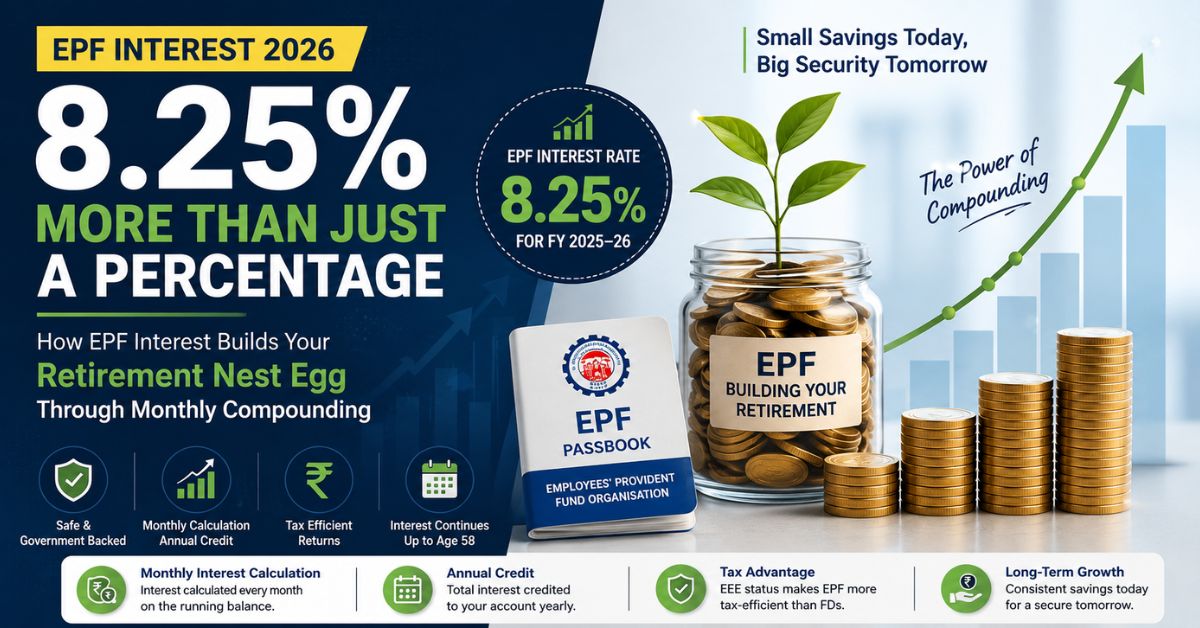
- The EPF interest rate is 8.25% for FY 2025-26, with interest calculated on the monthly running balance and credited annually after the applicable approval process.
- EPF compounding can materially increase the retirement corpus over a long working career because accumulated interest contributes to future growth.
- EPF can provide favourable tax treatment under the applicable income-tax rules, although interest attributable to employee contributions above the prescribed threshold can become taxable.
- EPFO has simplified its partial-withdrawal framework and continues to expand digital member services and account administration.
- Long-term employees can increase retirement savings through consistent EPF contributions and, where eligible, additional VPF contributions.
- Avoiding unnecessary withdrawals can help preserve the balance available for future EPF interest and compounding.
| EPF Feature | Current Position |
|---|---|
| FY 2025-26 Interest Rate | 8.25% |
| Interest Calculation | Calculated monthly on the running balance and credited annually |
| Employee Contribution | Generally 12% of Basic Wages plus Dearness Allowance, subject to applicable EPF rules |
| Employer Contribution | Contributes under the applicable EPF framework, with the relevant portion allocated between EPF and EPS |
| Compounding | Long-term accumulated balances can generate further interest over time |
| VPF | Eligible employees can make additional voluntary employee contributions through the EPF framework |
| Withdrawal | Subject to the applicable EPF withdrawal, advance and settlement rules |
For millions of salaried employees in India, the Employees’ Provident Fund, or EPF, remains one of the safest ways to build long-term retirement savings. In 2026, the EPF interest rate continues at 8.25%, making it one of the highest-return fixed-income savings options backed by the government.
While most employees know that EPF earns annual interest, many are still unclear about how the calculation actually works, when the interest gets credited, and why compounding plays such a major role in building a retirement corpus over time.
The way EPF interest is applied can significantly affect the final amount available at retirement. Even small monthly contributions made consistently over a long career can grow into a large savings pool because of compounding.
Calculate Your Provident Fund Corpus and Retirement Savings
Calculate Your Provident FundWhy the 8.25% EPF Interest Rate Matters
The Employees’ Provident Fund Organisation (EPFO) retained the EPF interest rate at 8.25% for FY 2025-26. The decision came at a time when many traditional savings products continue to offer lower post-tax returns.
Compared to several bank fixed deposits, EPF remains attractive because the returns are largely tax-free for eligible accounts and contributions within prescribed limits.
For salaried employees, EPF also provides disciplined savings because contributions happen automatically through payroll deductions. Over time, this creates a steady investment habit without requiring active financial planning every month. Employees looking for a broader explanation of EPFO’s digital transformation and service changes can also refer to our EPFO 3.0 Guide.
Financial planners often consider EPF one of the core retirement instruments for middle-income salaried households because of three factors:
- Stable government-backed structure
- Relatively high fixed-income returns
- Long-term compounding advantage
How EPF Interest Is Actually Calculated
A common misunderstanding is that EPF interest is calculated only once a year. In reality, the calculation happens every month on the running balance in the account.
However, the interest amount is credited to the EPF account annually, usually at the end of the financial year after official approval from the government.
This means:
- Monthly contributions continue increasing the balance
- Interest is calculated on that growing balance every month
- The total yearly interest is added as a lump sum entry later
The monthly interest rate for FY 2025-26 works out to 0.6875% per month.
Although the credit happens yearly, the monthly calculation method allows EPF balances to grow steadily throughout the year.
For example, if an employee receives salary hikes, bonus-linked contributions, or additional voluntary contributions during the year, those additions also begin earning interest based on the applicable monthly balance.
Understanding the Power of Compounding in EPF
Compounding is one of the biggest reasons why EPF becomes valuable over a long working career.
In simple terms, compounding means earning interest not only on your contributions but also on the interest accumulated from previous years.
In the early years of employment, most of the EPF balance comes from direct monthly contributions by the employee and employer. But after many years, the accumulated interest itself starts generating a substantial portion of the annual growth.
This is where long-term investing makes a major difference.
For employees who continue contributing consistently for 25 to 30 years, the final retirement corpus can become several times larger than the total amount personally contributed during the career.
Financial experts often describe this as the “snowball effect” of retirement savings.
Why EPF Often Delivers Better Post-Tax Returns Than Fixed Deposits
Bank fixed deposits continue to remain popular among conservative investors, but EPF usually offers stronger post-tax returns for salaried employees.
One major reason is taxation.
Interest earned on most bank fixed deposits is taxable according to the investor’s income tax slab. This reduces the effective return received after tax deductions.
EPF, on the other hand, generally follows the Exempt-Exempt-Exempt, or EEE, structure for eligible accounts. This means:
- Contributions may qualify for tax deduction
- Annual interest remains tax-free within prescribed limits
- Final maturity amount is usually tax-free under existing rules
The tax treatment makes a significant difference over long investment periods.
| Feature | EPF | Bank Fixed Deposit |
|---|---|---|
| Interest Rate | 8.25% | Around 6.5% to 7.5% |
| Tax on Interest | Mostly tax-free within limits | Taxable |
| Employer Contribution | Yes | No |
| Long-Term Retirement Benefit | High | Moderate |
However, employees should note that interest earned on employee contributions above ₹2.5 lakh in a financial year becomes taxable in many cases.
EPF Interest Trends Over the Last Few Years
EPF interest rates have changed over time depending on market conditions, bond yields, and earnings generated by EPFO investments.
Here is how the rates moved in recent years:
| Financial Year | EPF Interest Rate |
|---|---|
| 2025-26 | 8.25% |
| 2024-25 | 8.25% |
| 2023-24 | 8.15% |
| 2022-23 | 8.15% |
| 2018-19 | 8.65% |
The 8.65% rate seen in 2018-19 remains one of the highest levels in recent years. The reduction afterward reflected changing economic conditions and lower global interest-rate cycles.
Despite market volatility and inflation concerns, the EPFO has maintained the 8.25% rate for 2025-26, which many experts consider competitive compared to other low-risk savings instruments.
What Happens if You Stop Working
Many employees still believe that EPF accounts stop earning interest if contributions are discontinued for several years. This belief comes from older rules related to inactive accounts.
Under current EPFO norms, many inactive EPF accounts continue earning interest up to the age of 58 years, even if fresh contributions stop after leaving a job.
This becomes important for:
- Employees taking career breaks
- Professionals starting businesses
- Freelancers shifting out of salaried employment
- Workers temporarily unemployed
Instead of withdrawing the EPF amount immediately after changing jobs, many financial advisors recommend keeping the account active if the money is not urgently needed.
The reason is simple. The existing balance can continue growing at a relatively high interest rate without market risk.
How Voluntary Provident Fund Can Increase Retirement Savings
Employees who want to build a larger retirement corpus can also use the Voluntary Provident Fund, or VPF.
Under VPF, employees can contribute more than the mandatory 12% basic salary contribution toward provident fund savings.
The key advantage is that the extra contribution earns the same EPF interest rate of 8.25%.
For long-term savers, VPF can become an effective alternative to some debt-based investment products because:
- The returns are relatively stable
- Contributions happen automatically
- Compounding continues over many years
However, employees should also balance liquidity needs because EPF and VPF are long-term retirement-oriented products.
Why Early Withdrawals Can Hurt Long-Term Wealth
EPF allows partial withdrawals for specific purposes such as:
- Medical treatment
- Home purchase
- Marriage expenses
- Education
- Emergency needs
While these facilities provide financial support during important life events, frequent withdrawals can reduce long-term wealth creation.
Every withdrawal reduces the principal amount available for future compounding.
For example, withdrawing ₹1 lakh during the early years of employment may appear manageable in the short term, but over decades, that amount could have generated several lakhs through compound growth.
This is why retirement planners usually advise employees to avoid unnecessary withdrawals unless there is a genuine financial requirement.
EPF Remains a Core Retirement Tool in 2026
Even as investment options continue expanding across mutual funds, equities, and digital financial products, EPF remains one of the most important retirement savings instruments for salaried Indians.
The combination of automatic monthly investing, employer contribution, government-backed structure, relatively high interest rates, and tax efficiency continues to make EPF a strong long-term savings tool.
For younger employees especially, the biggest advantage is time. Starting early allows compounding to work over decades, which can substantially increase the final retirement corpus.
In many cases, the difference between a modest retirement fund and a financially comfortable retirement comes not from sudden large investments, but from consistent long-term contributions that remain untouched for years.