
Key Points
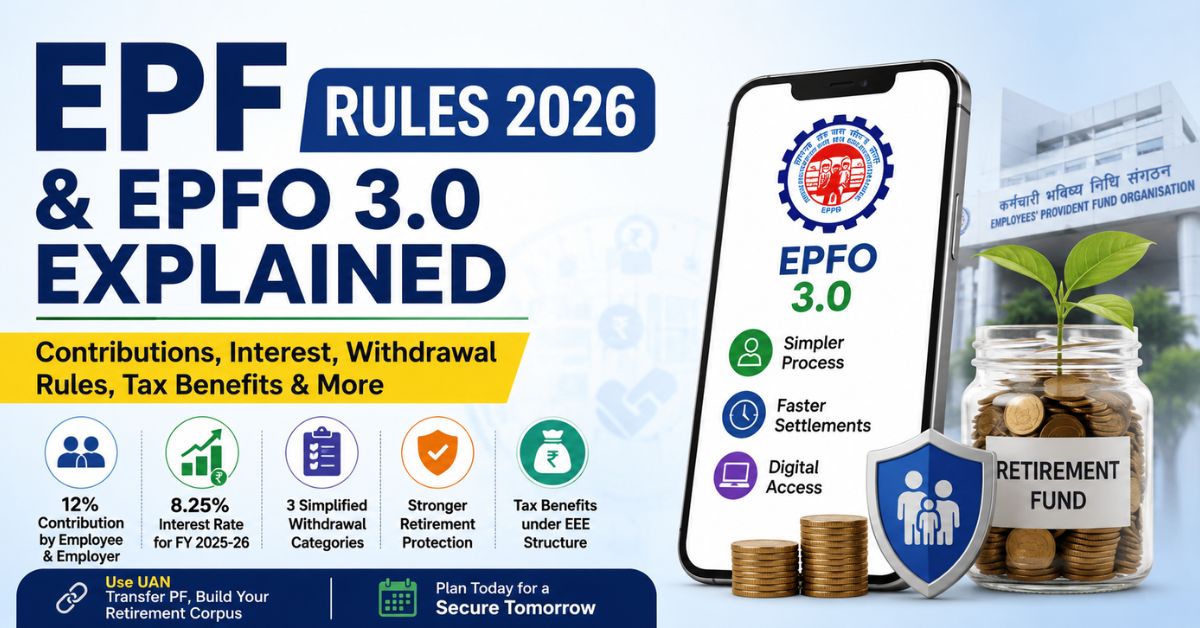
- EPF is a long-term retirement savings system administered by the Employees’ Provident Fund Organisation for eligible employees and establishments.
- The standard employee contribution is 12% of Basic Wages plus Dearness Allowance, while the employer contribution is allocated between EPF and EPS according to the applicable rules.
- The EPF interest rate for FY 2025-26 is 8.25%, with interest calculated using monthly balances and credited annually. citeturn3search2
- EPFO’s 2025 withdrawal reforms merged 13 partial-withdrawal provisions into three broad categories: Essential Needs, Housing Needs and Special Circumstances.
- Under the revised framework, members can access up to 75% of the eligible PF balance while 25% is retained as a minimum balance, subject to the applicable rules. citeturn3search0
- The Income-tax Act, 2025 replaced the Income-tax Act, 1961 from 1 April 2026 and retains the ₹1,50,000 aggregate deduction for specified savings, including provident fund contributions, under Section 123. citeturn2search5turn2search9
- EPFO’s 2026 digital upgrades include database consolidation, phased service restoration and Aadhaar-based Face Authentication through UMANG for UAN activation and generation. citeturn0search2turn0search1
| EPF Feature | Current Rule / Position |
|---|---|
| Employee Contribution | Generally 12% of Basic Wages plus Dearness Allowance, subject to applicable EPF rules |
| Employer Contribution | Generally 12%, with the applicable portion allocated to EPF and EPS |
| FY 2025-26 Interest Rate | 8.25% |
| Partial Withdrawal Categories | Essential Needs, Housing Needs and Special Circumstances |
| Minimum Service for Revised Partial Withdrawals | 12 months |
| Immediate Unemployment Withdrawal | Up to 75% of PF balance under the revised framework |
| Minimum Balance | 25% retained under the revised withdrawal framework |
| Tax Deduction in 2026 | ₹1,50,000 aggregate deduction for specified savings under Section 123 of the Income-tax Act, 2025, where the applicable tax regime permits it |
For millions of salaried employees in India, the Employees’ Provident Fund, commonly called EPF, remains one of the most important long-term savings tools. Every month, a fixed portion of salary goes into the EPF account, creating a retirement fund that continues to grow with compound interest over the years.
Employees trying to understand the broader structure of provident fund savings often look at PF contribution rules and employer matching structure to understand how monthly deductions and pension allocations actually work.
In 2026, the system is seeing major digital upgrades under EPFO 3.0. The Employees’ Provident Fund Organisation, or EPFO, has been working to simplify withdrawals, improve claim settlement speed, and make account access easier through digital services.
Even though EPF is mandatory for many employees, a large number of people still do not fully understand how interest is calculated, when withdrawals are allowed, and how retirement savings grow over long periods. Employees evaluating long-term savings growth frequently explore EPF interest calculation and compounding impact before planning retirement contributions.
Here is a complete guide to understanding EPF in simple terms.
Calculate Your Provident Fund Corpus and Retirement Savings
Calculate Your Provident FundWhat is EPF and Why Does it Matter?
EPF is a government-backed retirement savings scheme managed by the Employees’ Provident Fund Organisation under the Ministry of Labour and Employment.
The main purpose of EPF is to help salaried employees build financial security for retirement. Since both the employee and employer contribute every month, the account grows steadily over time.
Apart from retirement savings, EPF also supports employees during important life situations such as medical emergencies, home purchase, marriage expenses, education needs, unemployment, and retirement planning.
The scheme also offers tax benefits and annual interest, which makes it one of the most widely used savings systems in India.
How EPF Contributions Work
Under the standard EPF structure, both the employee and employer contribute 12% of the employee’s Basic Salary plus Dearness Allowance every month.
While many employees believe the entire employer contribution goes into the PF account, that is not exactly how the system works. The employer contribution is divided between EPF, EPS and other statutory components according to the applicable rules.
The employer contribution is divided into multiple components.
| Component | Employee Share | Employer Share |
|---|---|---|
| EPF (Provident Fund) | 12% | 3.67% |
| EPS (Pension Scheme) | 0% | 8.33% (Up to ₹1,250) |
| EDLI (Insurance) | 0% | 0.50% (Up to ₹75) |
The EPS contribution has a salary ceiling of ₹15,000. This means the maximum employer contribution towards EPS is capped at ₹1,250 per month.
For example, even if an employee earns a basic salary of ₹80,000 or ₹1 lakh, the employer will still contribute only ₹1,250 to the pension scheme. The remaining amount goes into the EPF account.
This is why employees with higher salaries often see a larger EPF balance but a fixed pension contribution.
Understanding EPS and EDLI
The Employee Pension Scheme is designed to provide pension benefits after retirement. Employees become eligible for pension benefits after completing the required years of service under EPFO rules.
EDLI works as a life insurance benefit linked to EPF membership. In case of the employee’s death during service, eligible nominees can receive insurance benefits under the scheme.
Employees do not need to make separate contributions for EDLI.
EPF Interest Rate in 2026
For FY 2025-26, the EPF interest rate is 8.25%. The rate is determined through the EPFO Central Board of Trustees process and is then approved by the Central Government before being credited to members’ accounts. citeturn3search2
Although the rate is declared for the financial year, EPF interest is calculated on the monthly running balance and credited annually. Members should use 8.25% as the current reference rate for FY 2025-26 rather than assuming that the same rate will apply permanently.
How Interest is Calculated
Interest is calculated on the closing balance at the end of every month.
However, the accumulated interest for the entire year is credited together at the end of the financial year, usually on March 31.
This system helps the EPF balance grow through compounding over long periods. Employees interested in understanding how compounding changes retirement savings over decades can read more about EPF interest compounding and retirement growth.
For salaried employees who continue contributions consistently for 20 to 30 years, the final retirement corpus can become substantial due to this compounding effect.
EPFO 3.0 and Digital Reforms
One of the biggest changes affecting EPF members is the continuing EPFO 3.0 digital transformation. The Central Board of Trustees approved a comprehensive member-centric digital transformation framework, while EPFO has also been carrying out database consolidation and software upgrades to improve service delivery. Employees looking for a broader explanation of these changes can read our EPFO 3.0 Guide.
EPFO has been working to reduce paperwork, improve automation, and simplify member services. In August 2026, EPFO also reported that its major database consolidation and software upgrade had been completed, with member and employer services being restored in phases and additional verification being used during post-migration stabilization.
Several processes that earlier required physical forms or employer approval are gradually becoming digital and faster.
- More digital and automated member services
- Simplified withdrawal categories and claim processing
- Improved online verification and profile services
- Greater use of Aadhaar-based digital authentication
- Database consolidation and upgraded EPFO service infrastructure
- Phased restoration and stabilization of member and employer services after the 2026 system upgrade
New EPF Withdrawal Rules Explained
EPFO simplified its partial-withdrawal framework in 2025 by merging 13 separate provisions into three broad categories: Essential Needs, Housing Needs and Special Circumstances. The revised framework also reduced the minimum service requirement for partial withdrawals to 12 months and expanded the amount that can be accessed by including both employee and employer contributions, along with interest, subject to the applicable withdrawal conditions. citeturn3search0turn3search2
| Withdrawal Category | Examples / Current Position |
|---|---|
| Essential Needs | Illness, education and marriage-related withdrawals |
| Housing Needs | Eligible house purchase, construction and related housing purposes |
| Special Circumstances | Specified circumstances where the revised framework allows access without the earlier need to navigate multiple separate provisions |
| Partial Withdrawal Limit | Up to 75% of the eligible PF balance can be accessed while 25% is retained as a minimum balance under the revised framework |
| Minimum Service | 12 months for the revised partial-withdrawal framework |
These changes are intended to make withdrawals easier to understand while retaining a portion of the retirement corpus. The government has clarified that the 25% retained balance is intended to preserve retirement savings and allow members to continue benefiting from EPF interest and compounding. citeturn3search0
Housing and Asset-Related Withdrawals
EPF can be used for eligible housing purposes, including purchase or construction of a house and specified housing-loan related requirements, subject to the applicable conditions. EPFO’s published guidance continues to list housing-related advances, including provisions that can permit withdrawal of up to 90% of the PF accumulation for specified house or housing-loan purposes. citeturn1search0
Employees planning withdrawals or estimating settlement values often review the detailed EPF withdrawal process and PF estimation rules before filing claims online.
Job Loss and Unemployment
EPFO has clarified the revised unemployment position following the 2025 withdrawal reforms. A member who loses a job can withdraw up to 75% of the PF balance immediately, while the remaining 25% can be accessed after one year of continuous unemployment under the revised framework. The revised rules were designed to balance access to savings with preservation of a retirement corpus. citeturn3search0turn3search4
| Situation | Current Withdrawal Position |
|---|---|
| Job loss / unemployment | Up to 75% of the PF balance can be withdrawn immediately |
| Continued unemployment for one year | The remaining 25% can become available, subject to the applicable rules |
| Specified full-settlement situations | Full withdrawal may be permitted in cases such as retirement, permanent disability, retrenchment, voluntary retirement or permanent migration, subject to the applicable provisions |
Employees should also understand potential TDS deductions and tax implications before withdrawing their balance. Detailed guidance regarding PF withdrawal tax rules and EPFO claim conditions can help avoid mistakes during settlement.
Why UAN is Important
The Universal Account Number, or UAN, acts as a permanent EPF identity for employees.
Keeping the same UAN active helps maintain service continuity, preserve retirement savings, and simplify account administration. EPFO’s current member portal states that UAN activation and new UAN generation can be completed through Aadhaar-based Face Authentication on the UMANG app, while direct UAN allotment and activation through the member portal have been discontinued. citeturn0search2
Frequent withdrawals after job changes can reduce the amount left invested for long-term retirement compounding. Employees evaluating future retirement planning often analyse how PF affects long-term retirement corpus growth before deciding whether to continue or withdraw contributions.
Tax Benefits of EPF in 2026
EPF continues to receive favourable tax treatment, but the legal reference changed in 2026. The Income-tax Act, 2025 came into force from 1 April 2026 and replaced the Income-tax Act, 1961 for the applicable tax years. The new Act retains the aggregate ₹1,50,000 deduction for specified savings instruments, including provident fund contributions, under Section 123. citeturn2search5turn2search9
The deduction is relevant to taxpayers using the tax regime under which the specified savings deduction is available. The Income Tax Department confirms that the corresponding deduction is not available under the new concessional tax regime. citeturn2search11
Interest on recognised provident fund balances continues to receive favourable treatment subject to the applicable contribution and tax rules. EPFO and the government also rationalised the income-tax framework for recognised provident funds in 2026 to align it more closely with EPFO rules. citeturn2search1
For final settlement, employees should check the continuous-service requirement and applicable exemption conditions rather than assuming that every withdrawal is automatically tax-free.
Should Employees Withdraw PF Frequently?
Financial planners generally advise against frequent PF withdrawals unless absolutely necessary.
The combination of monthly savings, employer contribution, annual interest, and long-term compounding makes EPF a powerful retirement planning tool.
Many employees also compare PF vs PPF differences for long-term savings while planning retirement investments and tax-efficient wealth creation strategies.
Common Mistakes Employees Make
- Withdrawing PF after every job switch
- Not activating UAN
- Ignoring nominee updates
- Failing to check passbook entries
- Not linking Aadhaar or bank details properly
- Delaying transfer requests
The Growing Role of EPF in Financial Planning
In recent years, rising living costs and concerns around retirement planning have made EPF even more important.
Unlike market-linked investments that fluctuate daily, EPF provides stable government-backed returns along with disciplined savings.
For many middle-class salaried families, EPF often becomes the single largest retirement asset outside real estate.
With ongoing digitisation and EPFO 3.0 reforms, the system is gradually becoming faster, more accessible, and easier for employees to use.