
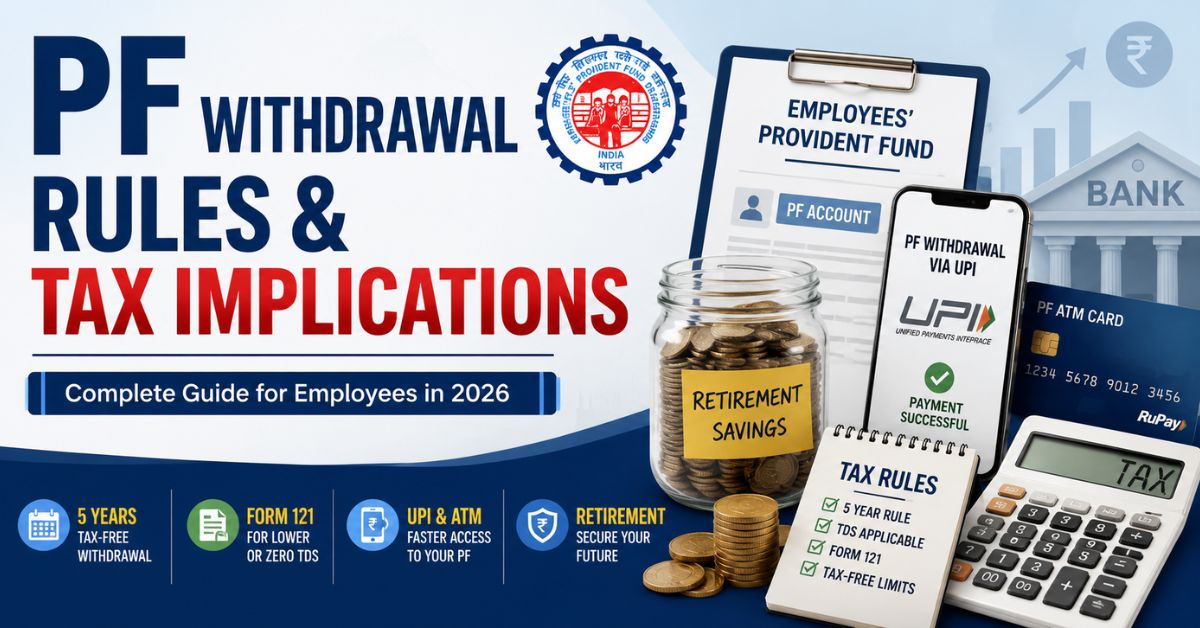
PF Withdrawal Rules and Tax Changes in 2026
- EPFO 3.0 reforms are making PF withdrawals faster through UPI, auto-settlement, and digital verification.
- PF withdrawals after five years of continuous service remain fully tax-free under existing income tax rules.
- TDS applies on withdrawals above ₹50,000 if employees withdraw before completing five years of service.
- Form 121 is expected to replace Forms 15G and 15H for eligible members seeking lower or zero TDS deduction.
- Employees are advised to check Aadhaar, PAN, service history, and bank approval status before filing claims.
Employees planning to withdraw money from their Provident Fund in 2026 are likely to see a faster and more digital process as the Employees’ Provident Fund Organisation, or EPFO, continues rolling out its EPFO 3.0 reforms. The updated framework focuses on quicker settlements, simplified online claims, Aadhaar-based verification, and new digital access systems such as UPI withdrawals and ATM-linked PF services.
At the same time, the tax rules linked to PF withdrawals remain largely unchanged. For salaried employees, the most important factor continues to be the length of continuous service. A wrong withdrawal decision can still lead to tax deductions, delayed processing, or loss of retirement savings.
PF Withdrawal Rules in 2026
The Provident Fund system was originally designed as a retirement savings scheme, where both the employer and employee contribute every month. However, EPFO rules allow members to withdraw funds partially or fully under specific situations.
Under the newer EPFO 3.0 approach, withdrawal categories are being presented in a more simplified format to improve understanding among employees.
The broad categories now include:
- Essential needs such as medical treatment, education, and marriage
- Housing-related withdrawals for home purchase, construction, or loan repayment
- Special situations including unemployment, retirement, or natural disasters
For medical emergencies, members can usually apply for withdrawal without completing a minimum service period. Education and marriage withdrawals may require at least one year of service under the updated guidance being discussed across financial platforms.
Housing withdrawals continue to require longer service history, generally around five years. Members using PF for home loan repayment may become eligible earlier under specific conditions.
Several reports discussing EPFO 3.0 also mention a retirement protection mechanism where members may need to leave around 25 percent of the PF corpus untouched during partial withdrawals. The purpose of this approach is to prevent workers from exhausting retirement savings too early. However, experts note that this rule is still evolving and may not yet be implemented uniformly across all categories.
When PF Withdrawal Becomes Tax-Free
The biggest factor deciding whether PF withdrawal is taxable or tax-free is the employee’s total years of continuous service.
According to existing income tax rules, PF withdrawal becomes fully tax-free if the employee completes at least five years of continuous service before withdrawing the amount.
This tax-free treatment usually applies to:
- Employee contribution
- Employer contribution
- Interest earned on the PF balance
Employees who switch jobs should remember that continuous service can still be counted if the PF account is properly transferred from one employer to another. Financial advisers often recommend transferring PF balances instead of closing accounts during job changes because breaking the service chain may affect tax benefits later.
For example, if an employee worked three years at one company and two years at another company while transferring the PF balance correctly, the total service period may still be treated as five continuous years.
This rule becomes especially important for younger employees who frequently change jobs in the private sector.
Tax Implications of PF Withdrawal Before Five Years
If an employee withdraws PF before completing five years of continuous service, the withdrawal generally becomes taxable.
The withdrawn amount may be added to the employee’s total income and taxed according to the applicable income tax slab.
In such cases:
- Employer contribution may become taxable
- Interest earned on employer contribution may become taxable
- Earlier tax deductions claimed under Section 80C may also get reversed in some situations
Tax experts often advise employees to calculate the actual tax impact before withdrawing PF early because the final tax liability can sometimes be higher than expected.
Many employees mistakenly assume that only TDS will apply. However, TDS is only a preliminary deduction. The final tax calculation still depends on the individual’s total annual income.
TDS Rules on PF Withdrawal
Tax Deducted at Source, commonly called TDS, becomes applicable if an employee withdraws more than ₹50,000 before completing five years of continuous service.
The TDS rates generally work as follows:
| Documentation Status | TDS Rate |
|---|---|
| PAN submitted | 10% |
| PAN not submitted | Maximum marginal rate, around 34.6% |
| Form 121 submitted and eligible | Nil TDS in eligible cases |
The sharp increase in deduction when PAN is not linked remains one of the biggest reasons employees face large cuts in PF settlement amounts.
Because of this, experts strongly recommend checking whether PAN, Aadhaar, and bank details are correctly updated on the UAN portal before filing a withdrawal request.
What is Form 121 and Why it Matters
One of the major updates being discussed in 2026 is the introduction of Form 121.
According to multiple financial reports, Form 121 replaces the earlier Forms 15G and 15H that were used to request lower or zero TDS deduction.
Employees whose total annual income remains below the taxable limit may be able to use Form 121 to avoid TDS on PF withdrawal.
However, financial planners caution that avoiding TDS does not automatically make the withdrawal tax-free. If the employee’s total income eventually exceeds the exemption limit during the financial year, tax may still become payable while filing the income tax return.
This makes income estimation important before submitting Form 121.
UPI and ATM-Based PF Withdrawals Under EPFO 3.0
One of the most discussed changes under EPFO 3.0 is the move toward faster digital withdrawals.
Traditionally, PF withdrawal involved multiple verification steps, employer approvals, and long waiting periods. The newer system aims to reduce this dependence through Aadhaar authentication and automated settlement systems.
Under the updated framework being rolled out, eligible members may be able to withdraw part of their PF balance directly through UPI-linked applications such as Google Pay and PhonePe.
Reports indicate that up to 75 percent of eligible balances could become accessible for emergency non-refundable advances through instant digital systems.
EPFO is also working on ATM-linked withdrawal facilities for members. Under this model, eligible users may receive a dedicated PF withdrawal card that can be used at approved ATM networks.
The feature is expected to benefit users with limited internet access or lower digital familiarity.
Auto-Settlement and Faster PF Claims
EPFO has also expanded the use of AI and machine learning systems for claim settlement.
Claims below certain limits, reportedly around ₹5 lakh, may now be processed automatically without manual officer approval in many cases.
This auto-settlement system is aimed at reducing processing delays and improving efficiency.
Several financial reports suggest that straightforward claims may now reach bank accounts within a few days if KYC details are correctly updated and no verification issues are found.
However, experts warn that name mismatches, inactive bank accounts, or incomplete Aadhaar verification can still delay settlements despite the automated system.
Rules for Full PF Withdrawal
Complete PF withdrawal continues to remain restricted to specific situations.
Employees can usually withdraw the full PF amount under the following circumstances:
- Retirement after reaching 58 years of age
- Long-term unemployment
- Permanent migration abroad
- Foreign employment opportunities
Earlier EPFO rules allowed full withdrawal after two months of unemployment. However, several recent reports suggest that the unemployment period required for final settlement may now be extended under revised EPFO guidance.
Since implementation details are still evolving, employees are advised to verify the latest rules directly through official EPFO notifications before filing final settlement claims.
Important Things Employees Should Check Before Withdrawal
Financial advisers say employees should review several details before applying for PF withdrawal.
These include:
- Aadhaar linking status
- PAN verification
- Digitally approved bank account
- Correct service history
- Updated mobile number linked with UAN
The “Service History” section available on the UAN portal is particularly important because it helps determine whether the employee qualifies for tax-free withdrawal under the five-year rule.
Employees should also avoid withdrawing PF casually during every job change because repeated early withdrawals can significantly reduce retirement savings over time.
Why PF Withdrawal Decisions Matter for Long-Term Savings
Although the newer EPFO system is becoming faster and more convenient, financial planners continue advising employees to treat PF primarily as a retirement asset rather than a short-term emergency fund.
PF continues to offer relatively stable returns along with long-term tax advantages for eligible members. Premature withdrawal may reduce the power of compounding and weaken retirement security later in life.
As EPFO 3.0 reforms continue expanding across India, employees are expected to benefit from faster claims, digital withdrawals, and simpler processing systems. However, understanding the tax implications, service rules, and documentation requirements remains essential before making any withdrawal decision.