
AI Stock Bubble or Once-in-a-Generation Opportunity?
A Complete Market Psychology Case Study
Introduction: The Investment Story That Is Reshaping Global Markets
Every decade has a defining investment story.
In the 1980s, investors chased personal computers.
In the 1990s, the internet became the biggest opportunity on Wall Street.
In the 2000s, emerging markets captured global attention.
In the 2010s, cloud computing transformed technology companies into trillion-dollar giants.
And now, in 2026, one theme dominates almost every investor conversation:
From Wall Street analysts to retail investors, from Silicon Valley founders to government policymakers, everyone seems to be talking about AI.
Billions of dollars are flowing into AI infrastructure. Data centers are expanding rapidly. Technology companies are racing to build increasingly powerful AI systems.
And investors are asking one important question:
The answer may determine where trillions of dollars move over the next decade.
Why AI Has Become the Biggest Investment Theme on Earth
To understand why investors are pouring money into AI, we must first understand what makes this technological wave different.
Most technological revolutions improve a specific industry. Artificial Intelligence has the potential to impact nearly every industry — Healthcare, Finance, Manufacturing, Education, Transportation, Retail, Software development, and Customer service.
Unlike many previous innovations, AI is not targeting one market. It is targeting almost all markets simultaneously.
The Numbers Behind the AI Boom
When market historians look back at this period, one statistic will likely stand out. The amount of capital being invested into AI infrastructure is unprecedented.
Technology giants are spending hundreds of billions of dollars on AI data centers, advanced semiconductor chips, cloud infrastructure, machine learning systems, AI research and development, and energy infrastructure for computing.
This is not the behavior of companies making small experimental bets. These are some of the largest corporate investments in modern history.
According to Goldman Sachs Research (2025), global AI infrastructure investment is projected to exceed $1 trillion by 2030. Microsoft, Google, Meta, and Amazon collectively committed over $320 billion in capital expenditure for 2025 alone, with AI infrastructure as the primary driver (company earnings reports, Q4 2024). Nvidia's data center revenue grew from approximately $15 billion in FY2023 to over $47 billion in FY2024, a growth rate exceeding 200% year-over-year (Nvidia Annual Report, 2024). The global AI market size was valued at approximately $196 billion in 2023 and is projected to grow at a CAGR of over 36% through 2030 (Grand View Research, 2024).
| Technology Era | Primary Investment Theme | Economic Impact |
|---|---|---|
| 1980s | Personal Computers | Digital Workplace |
| 1990s | Internet | Online Economy |
| 2010s | Cloud Computing | Digital Transformation |
| 2020s | Artificial Intelligence | Potential Productivity Revolution |
Why Some Investors Are Calling It a Bubble
Whenever investors hear stories about life-changing gains, market history raises an important warning sign. Excessive optimism can eventually become dangerous.
Throughout history, bubbles have shared similar characteristics: extraordinary excitement, rapid price increases, fear of missing out (FOMO), aggressive speculation, and belief that "this time is different".
Many analysts believe parts of today's AI market display some of these characteristics. Valuations have expanded dramatically. Some companies have experienced explosive share-price growth in a very short period. And perhaps most importantly, AI has become a dominant narrative.
History teaches us that when excitement becomes universal, risk often increases.
The Question Every Investor Is Asking
If AI truly transforms the global economy, current valuations may eventually appear reasonable. If expectations prove too optimistic, significant corrections could occur.
That uncertainty is exactly what makes this one of the most fascinating investment stories of our generation. The challenge is separating genuine innovation from excessive speculation. And to do that, we must look at history.
The Dot-Com Bubble: The Comparison Everyone Is Making
Whenever a new technology captures global attention, investors immediately begin searching for historical parallels. Today, almost every discussion about Artificial Intelligence eventually reaches the same question:
To answer that question, we need to travel back more than two decades — back to a period when investors believed a revolutionary technology would permanently change the world. Ironically, they were right. The internet did transform the world. The problem was not the technology.
The problem was investor expectations.
What Actually Happened During the Dot-Com Era?
During the late 1990s, internet adoption was accelerating rapidly. Investors became convinced that traditional business rules no longer mattered. Many companies added ".com" to their names and immediately attracted investor attention — some had minimal revenue, some had no profits, a few barely had functioning business models.
Yet investors continued buying because everyone believed the future would justify today's prices. For a while, that strategy appeared brilliant. Stock prices soared. Retail participation exploded. Financial media celebrated every new technology company.
Then reality arrived. Many businesses failed to deliver the growth investors expected. The bubble burst. Billions of dollars disappeared.
The NASDAQ Composite Index peaked at 5,048 in March 2000. By October 2002, it had fallen to approximately 1,114 — a decline of nearly 78%. An estimated $5 trillion in market capitalization was wiped out between 2000 and 2002. Approximately 48% of dot-com companies that went public between 1999 and 2000 had failed by 2004 (Ritter, 2003). Even Amazon saw its stock fall over 90% from its 1999 peak before eventually recovering.
Similarities Between the AI Boom and the Dot-Com Boom
This is where the comparison becomes interesting. There are undeniable similarities between the AI boom and the internet boom.
| Dot-Com Era (1990s) | AI Era (2020s) |
|---|---|
| Revolutionary technology | Revolutionary technology |
| Massive media attention | Massive media attention |
| Retail investor excitement | Retail investor excitement |
| Valuation expansion | Valuation expansion |
| Fear of missing out | Fear of missing out |
| Speculative investments | Speculative investments |
At first glance, the similarities look concerning. And this is exactly why many analysts are warning investors to remain cautious.
The Most Important Difference Nobody Talks About
However, there is one major difference between today's AI leaders and many internet companies of the late 1990s. The biggest AI companies are already generating enormous revenues. Many are highly profitable, possess massive cash reserves, and already dominate global markets.
| Dot-Com Bubble | AI Leaders Today |
|---|---|
| Many companies had no profits | Strong profits |
| Weak business models | Proven business models |
| Limited cash flow | Massive cash flow |
| Future promise only | Future promise + present earnings |
This does not mean AI stocks cannot become overvalued. They absolutely can. But it does mean the comparison is more nuanced than many headlines suggest.
The Psychology of Every Technology Boom
The most fascinating part of this story is not technology. It is human behavior. Whether the year is 1999 or 2026, investors tend to behave in remarkably similar ways.
New Technology Appears → Early Investors Profit → Media Coverage Expands → Retail Investors Join → FOMO Accelerates → Valuations Expand → Reality Tests Expectations
Early Investors Profit: Returns in the early stage are often exceptional, creating compelling stories that spread rapidly. During the dot-com era, the NASDAQ returned over 85% in 1999 alone.
FOMO Accelerates: Behavioral economists define FOMO-driven buying as "herding behavior" — when individuals follow the crowd rather than conducting independent analysis. Nobel Prize-winning economist Robert Shiller described this as "irrational exuberance" in his landmark 2000 book.
Reality Tests Expectations: This stage is particularly painful because it can arrive without warning. Valuations do not correct gradually — they often correct sharply, leaving late investors with significant losses even if the underlying technology eventually succeeds.
The technology changes. The psychology rarely does.
The Real Risk Investors Should Be Watching
Many investors focus on whether AI will succeed. That may actually be the wrong question. A more important question might be:
Great businesses can still produce disappointing investment returns if investors pay excessively high prices. This lesson has repeated throughout market history and remains just as relevant in the AI era.
The Companies Powering the AI Revolution
Every major technological revolution creates winners. During the railroad boom, infrastructure companies became critical. During the internet revolution, networking and software companies dominated. And during the AI revolution, a completely new ecosystem is emerging.
Many investors focus only on chatbots and AI applications. However, behind every AI model exists a massive network of chips, data centers, cloud infrastructure, electricity, software, and computing power. Understanding this ecosystem is essential because the biggest profits often go to the companies supplying the tools rather than the companies using them.
Nvidia: The Face of the AI Boom
No company symbolizes the AI revolution more than NVIDIA. Originally known for gaming graphics cards, Nvidia has transformed into one of the most important technology companies in the world. Its advanced GPUs have become the preferred hardware for training and running AI models.
Whether it is a chatbot, image generator, recommendation engine, or enterprise AI solution, there is a strong chance Nvidia hardware is involved somewhere in the process. This has created extraordinary demand for Nvidia's products.
Key Question: Can Nvidia continue growing fast enough to justify investor expectations? With AMD, Intel, and custom chips from Amazon (Trainium), Google (TPU), and Meta rapidly improving, competition is intensifying.
Microsoft and OpenAI: The Partnership That Changed Everything
When generative AI exploded into public awareness, one partnership stood out. The relationship between Microsoft and OpenAI accelerated the commercialization of artificial intelligence. OpenAI demonstrated what modern AI systems could achieve. Microsoft provided cloud infrastructure, enterprise distribution, and financial support.
The result was one of the most significant partnerships in modern technology history. AI capabilities began appearing across productivity software, enterprise platforms, search experiences, and developer tools.
Some of the largest beneficiaries could be existing technology giants capable of integrating AI into products used by billions of people.
Amazon, Google, and the Cloud Computing Battle
Artificial Intelligence requires enormous computing power. That is why cloud infrastructure has become one of the most important parts of the AI ecosystem. Companies such as Amazon, Alphabet, and Microsoft operate massive cloud networks that allow businesses to deploy AI applications without building their own infrastructure.
This feedback loop is one reason investors remain optimistic about long-term AI growth.
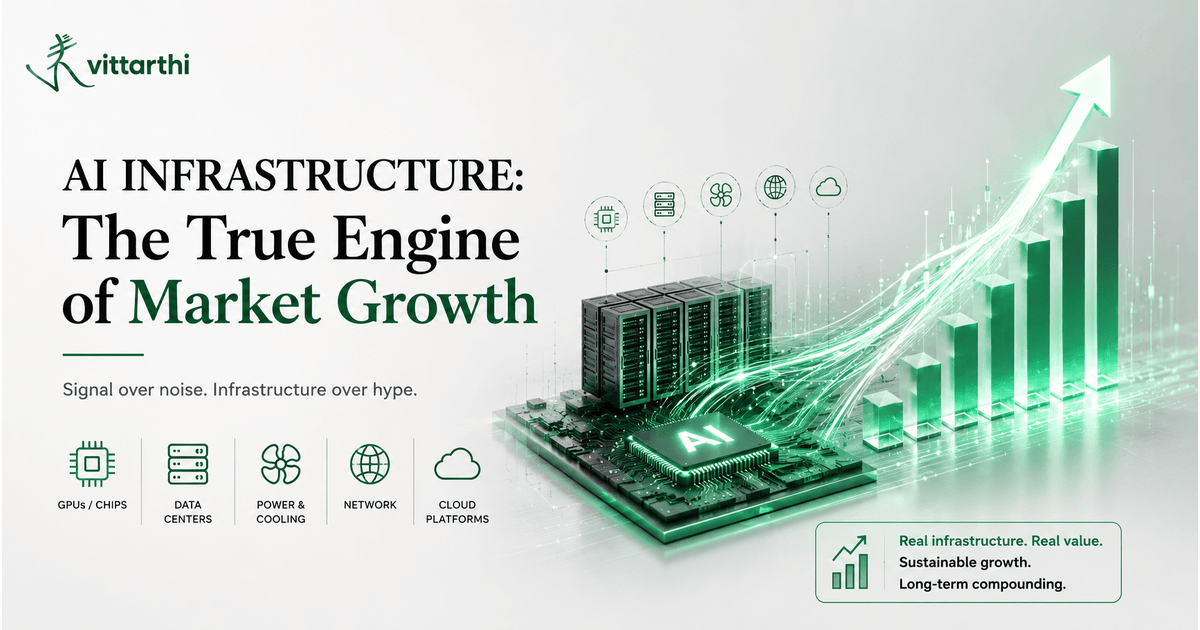
The AI Infrastructure Arms Race
One of the most overlooked aspects of the AI boom is infrastructure. Most people see AI through applications. Investors should also look beneath the surface. Data centers are being expanded at unprecedented speed. Energy demand is rising. Semiconductor production is increasing. Governments are competing for AI leadership.
The US alone added an estimated 24 gigawatts of new data center capacity in 2024, more than in the previous five years combined (Lawrence Berkeley National Laboratory, 2024). AI data centers are projected to consume approximately 8% of total US electricity by 2030, up from under 2% in 2022 (Goldman Sachs Power Up Report, 2024). The CHIPS and Science Act committed $52 billion to domestic semiconductor manufacturing, with the EU's Chips Act adding another €43 billion for similar purposes.
| AI Ecosystem Layer | Examples | Importance |
|---|---|---|
| Chips | Nvidia, AMD | Computing Power |
| Cloud | AWS, Azure, Google Cloud | Infrastructure |
| Models | OpenAI, Anthropic | Intelligence Layer |
| Applications | Business Software | End-User Value |
Where Could Investors Be Underestimating AI?
Many investors focus only on stock prices. History suggests that the biggest impact of major technologies often appears years after the initial excitement. The internet changed commerce. Cloud computing changed software. Smartphones changed communication. AI may eventually change productivity across entire economies.
If that happens, current expectations may actually underestimate the long-term impact. That possibility is one reason investors remain divided — some see a bubble, others see the beginning of a technological transformation comparable to the internet itself.
The Critical Question Investors Must Answer
AI is clearly real. The investments are real. The revenues are real. The technological progress is real. But markets are not asking whether AI is real. Markets are asking whether current valuations accurately reflect future growth. That is where risk and opportunity intersect.
The Biggest Risks Facing AI Investors
Every great investment opportunity comes with risk. The larger the opportunity, the larger the expectations. And expectations are often where market problems begin. Many investors today assume that AI growth will continue uninterrupted for years. History suggests markets rarely move in straight lines. Even revolutionary technologies experience corrections, disappointments, and periods of excessive optimism.
Risk #1: Valuations Running Ahead of Reality
The biggest risk is not AI failure. The biggest risk is expectations becoming larger than actual business performance. Markets are forward-looking. Investors are already pricing in years of future growth. If growth slows even slightly, valuations can compress rapidly.
Risk #2: Competition Could Reduce Profits
Today many AI leaders enjoy strong market positions. However, competition is increasing every year. New AI models are appearing. Open-source alternatives are improving. Governments are supporting domestic AI initiatives. As competition increases, profit margins could face pressure.
Risk #3: Regulatory Challenges
Artificial Intelligence is becoming increasingly powerful. With greater power comes greater regulatory attention. Governments around the world are discussing data privacy rules, AI transparency requirements, copyright concerns, national security implications, and workforce disruption policies.
The Bull Case: Why AI Could Still Be Underestimated
What if investors are actually underestimating AI? This possibility sounds surprising because AI already dominates headlines. Yet history suggests transformative technologies often take decades to reach their full potential. The internet existed long before e-commerce reached today's scale. Smartphones existed long before they transformed everyday life. AI may follow a similar path.
Opportunity #1: Productivity Revolution
The strongest argument for AI is productivity. Businesses constantly search for ways to produce more output with fewer resources. AI can automate repetitive tasks, accelerate research, assist decision-making, and improve efficiency. If productivity rises significantly, economic growth could increase for years.
Opportunity #2: New Industries May Emerge
Most investors focus on existing companies. However, some of the biggest winners may not exist yet. The internet created social media companies, e-commerce giants, streaming platforms, and digital advertising businesses. Similarly, AI may create entirely new industries over the next decade.
Opportunity #3: Global Adoption Is Just Beginning
Many businesses are still experimenting with AI. Large-scale deployment remains in its early stages. If adoption accelerates globally, AI spending could continue growing for years.
What Retail Investors Should Learn From This Case Study
The AI boom provides several lessons that extend beyond technology investing.
| Lesson | Meaning |
|---|---|
| Technology Matters | Innovation creates opportunities |
| Valuation Matters | Price still determines returns |
| Psychology Matters | FOMO can destroy discipline |
| Patience Matters | Compounding requires time |
| Diversification Matters | No theme is risk-free |
Diversification: The Strategy Most AI Investors Overlook
When a single investment theme dominates headlines, diversification often becomes the most neglected principle. Many retail investors today have concentrated significant portions of their portfolio in a handful of AI-related stocks. This approach can produce extraordinary returns if the theme continues. It can also produce extraordinary losses if the theme corrects.
Diversification in the context of AI investing means several things:
- Across the AI ecosystem: Owning chips, cloud, software, and application layer companies rather than just one segment reduces single-company risk.
- Across sectors: AI productivity gains may benefit industries outside technology — healthcare, industrials, and financial services could be significant long-term AI winners too.
- Across geographies: AI development is global. Companies in Asia, Europe, and emerging markets are also building significant AI capabilities.
- Across asset classes: Balancing AI equity exposure with bonds, commodities, or other asset classes reduces overall portfolio volatility.
No single theme — no matter how compelling — should dominate a prudently constructed long-term portfolio. This is not a pessimistic view of AI. It is simply sound investing discipline that applies equally to every exciting theme in market history.
The best investors understand both opportunity and risk simultaneously. They avoid extreme optimism and extreme pessimism. Instead, they focus on probabilities.
Final Verdict: Bubble, Boom, or Both?
After analyzing market history, investor psychology, infrastructure spending, company fundamentals, and technological progress, a balanced conclusion emerges.
But parts of the market may be experiencing bubble-like behavior.
That distinction is critical. The technology itself appears genuine. The business investments are real. The infrastructure spending is real. The productivity potential is real.
However, investor enthusiasm occasionally moves faster than business reality. That has happened throughout market history. And it will likely happen again.
The winners over the next decade may not be investors who simply chase the hottest AI stock. The winners may be those who understand the difference between innovation and speculation.
Artificial Intelligence may do the same.
The real challenge for investors is not identifying the revolution.
It is identifying which investments will benefit most from that revolution without overpaying for the opportunity.
Frequently Asked Questions (FAQs)
Is AI currently in a bubble?
Some AI-related stocks may exhibit bubble-like characteristics — particularly companies with high valuations and limited current revenues. However, the broader AI industry is supported by real revenue growth, large-scale infrastructure spending, and genuine technological adoption. The most accurate view is that the AI theme contains both well-grounded investments and speculative excess simultaneously. Investors should evaluate each company individually rather than treating all AI stocks as identical.
Is AI comparable to the Dot-Com Bubble?
There are meaningful similarities — rapid valuation expansion, intense retail investor excitement, and widespread fear of missing out. However, there is a critical difference: many leading AI companies today generate significant revenue and profits, hold enormous cash reserves, and have demonstrated proven business models. Dot-com era companies frequently had none of these. The NASDAQ's P/E ratio exceeded 200x at the bubble's peak in 2000; today's leading AI companies, while expensive, are not near those extremes. The comparison is a useful caution, but should not be treated as an exact repeat.
What is the biggest opportunity in AI investing?
The largest long-term opportunity may be AI-driven productivity improvements across industries. McKinsey estimates generative AI could add $2.6 to $4.4 trillion in annual value globally. Beyond direct AI companies, the biggest beneficiaries may include industries adopting AI most aggressively — such as healthcare (drug discovery, diagnostics), financial services (fraud detection, trading), and industrial manufacturing (predictive maintenance, quality control). Identifying which companies will convert AI adoption into durable competitive advantage is the core challenge for investors today.
What is the biggest risk for AI investors?
The biggest risk is paying excessively high valuations based on future expectations that may take longer to materialize than investors anticipate. A secondary but significant risk is competitive disruption — as the DeepSeek episode in January 2025 demonstrated, a single competitive breakthrough can erase hundreds of billions in market value within hours. Regulatory risk, particularly from the EU AI Act and potential US AI legislation, adds another layer of uncertainty. Investors should also be aware that even correct long-term predictions can produce poor returns if the purchase price was too high.
Should I invest in AI stocks in 2026?
This is a personal financial decision that depends on your individual risk tolerance, investment horizon, existing portfolio composition, and financial goals. What this case study can offer is a framework: AI represents a genuine long-term technological trend, but current valuations already reflect significant future growth expectations. Rather than chasing the most popular AI stocks at elevated prices, investors may benefit from a disciplined, diversified approach — spreading exposure across the AI ecosystem, maintaining position sizing discipline, and avoiding concentrating savings in a single theme. As always, consulting a qualified financial advisor before making significant investment decisions is strongly recommended. Nothing in this article constitutes financial advice.
How should I diversify within AI investing?
A common approach is to spread AI exposure across different layers of the ecosystem: semiconductor companies (hardware), cloud providers (infrastructure), AI model developers (intelligence), and companies integrating AI into existing products (end-user value). This way, even if one layer of the AI stack faces competitive pressure or valuation correction, other layers may continue performing well. AI-focused ETFs offer a simple way to gain diversified AI exposure without single-stock concentration risk. However, investors should research expense ratios and underlying holdings carefully before investing in any fund.
What happened to the winners of the Dot-Com era and what does that mean for AI?
Of the internet era's most hyped companies, a small number — Amazon, Google, eBay — survived and became among the world's most valuable businesses. The majority either failed completely or significantly underperformed. This suggests a pattern: within every major technology boom, a handful of companies eventually justify even initially extreme valuations, while the majority do not. For AI investors, this means selectivity matters enormously. Owning the entire AI theme through a diversified fund may be safer for most investors than attempting to identify individual winners, given how difficult it historically has been to predict which companies will emerge as lasting leaders of a new technology era.
Data Sources Referenced: Goldman Sachs Research (2024, 2025), McKinsey Global Institute (2023, 2024), Grand View Research (2024), Nvidia Annual Reports (2023, 2024), Lawrence Berkeley National Laboratory (2024), MIT Economics Research (Acemoglu & Johnson, 2024), Journal of Finance (Ritter, 2003).
Tags & Keywords: AI Stock Bubble, AI Investing, Nvidia Stock Analysis, Artificial Intelligence Stocks, Dot-Com Bubble Comparison, AI Market Case Study, Technology Investing, Market Psychology, AI Infrastructure, Future of AI, AI Revolution, Growth Investing.