
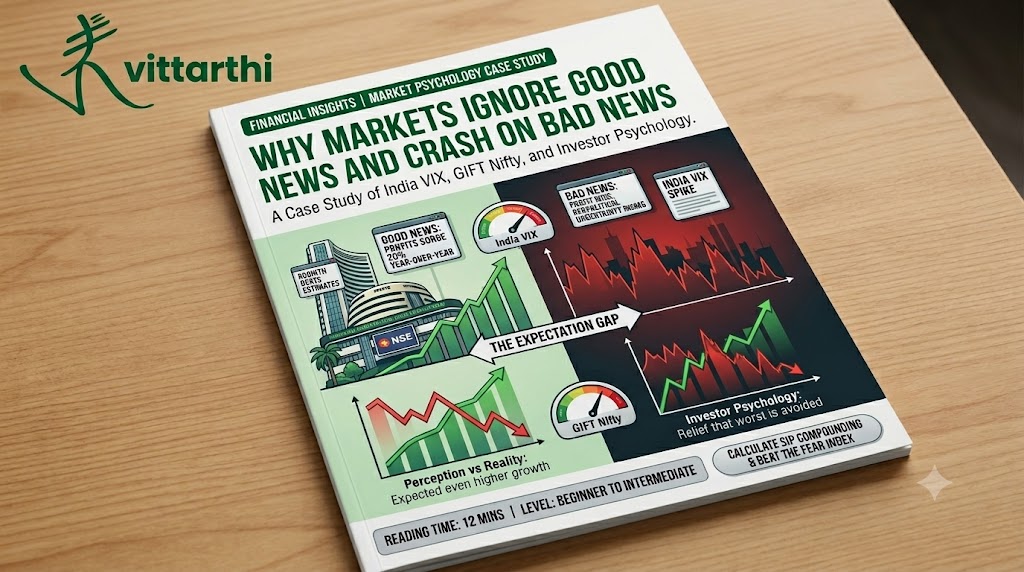
Why Markets Ignore Good News and Crash on Bad News: A Case Study of India VIX, GIFT Nifty, and Investor Psychology
Platform: Vittarthi Financial Insights | Level: Beginner to Intermediate
Introduction
Every Sunday evening, millions of traders and investors across India perform the same ritual. They open financial websites, check global markets, monitor crude oil prices, look at GIFT Nifty, track India VIX, read expert opinions, and then they ask one question:
"What will happen when the market opens tomorrow?"
Despite access to unprecedented amounts of information, predicting short-term market movements remains one of the most difficult challenges in finance. The reason is simple: Markets are not driven purely by data. Markets are driven by human behavior.
This Vittarthi case study explores how indicators such as India VIX, GIFT Nifty, crude oil prices, geopolitical tensions, and institutional money flows interact to influence market sentiment and investor decision-making. More importantly, it explains why markets sometimes rise despite bad news and fall despite good news — a phenomenon that confuses beginners and even experienced investors alike.
Explore our recent deep-dives into market movements and stock selection:
📌 Key Takeaways from This Case Study
- Markets react to the gap between expectations and reality, not just the news itself.
- India VIX measures expected volatility — a rising VIX does not mean markets will crash.
- GIFT Nifty provides early sentiment clues but is frequently reversed once trading begins.
- Institutional investors and retail investors behave fundamentally differently during volatility.
- Confusing volatility with risk is the most common and costly beginner mistake.
- Inflation erodes real returns — understanding nominal vs. real gains matters for every investor.
Understanding Market Psychology
Most beginners believe markets move because of news. Experienced investors know something different. Markets move because of expectations.
This is one of the most counterintuitive concepts in investing. Here is how it works in practice:
Scenario A: Good News, Stock Falls
A company reports profits that are higher than last year. Even though it sounds positive, the stock may still fall if investors expected even better results.
Real example: Infosys Q3 FY2024 — revenue grew but guidance disappointed. Stock fell 8% intraday despite solid numbers.
Scenario B: Bad News, Stock Rises
A company reports profits that are lower than expected. The stock may rally if investors feared something much worse.
Real example: Indian markets opened gap-down during the Russia-Ukraine escalation (Feb 2022), then recovered and closed green within days.
Markets react not to reality. Markets react to the gap between reality and expectations.
This is sometimes called the "buy the rumour, sell the news" effect. When positive expectations are already priced into a stock or index, even genuinely good news provides no additional upside — resulting in a sell-off by those who bought in anticipation.
The Sunday Night Ritual
Before Monday's market opening, traders typically focus on several indicators. These include: GIFT Nifty, India VIX, Crude Oil, US Markets, Asian Markets, FII Activity, DII Activity, Currency Movements, and Global News.
Each indicator provides clues about investor sentiment. However, no single indicator can predict market direction with certainty. Understanding how these indicators interact is far more important than analyzing them individually.
How to Read Multiple Indicators Together
Consider this example: GIFT Nifty is +100 points (positive), but India VIX has jumped from 13 to 19 overnight (fear spiking), crude oil is up 3% (inflationary pressure), and FII data shows net selling of ₹2,500 crore the previous week. A beginner sees "GIFT Nifty green" and expects a rally. An experienced investor sees a high-fear, high-volatility setup and waits for confirmation before acting.
What Is GIFT Nifty?
GIFT Nifty (formerly SGX Nifty) trades on the NSE International Exchange located at GIFT City, Gujarat. Because it trades for extended hours — including when Indian domestic exchanges are closed — investors use it to gauge overnight and early-morning sentiment before the NSE and BSE open at 9:15 AM IST.
Many beginners mistakenly assume: GIFT Nifty Up = Market Up, and GIFT Nifty Down = Market Down. Reality is much more complicated. Consider the following:
| GIFT Nifty Indication | Market Open | Closing Result | Why This Happens |
|---|---|---|---|
| Positive | Gap Up | Closed Red | Profit booking after gap-up; FIIs selling into the rally |
| Negative | Gap Down | Closed Green | DIIs buying at lower levels; panic was overdone |
| Positive | Flat | Closed Red | Domestic triggers (macro data, RBI policy) overrode global cues |
| Negative | Flat | Closed Green | Strong quarterly results from heavyweights like RIL or HDFC Bank |
The reason is that GIFT Nifty reflects expectations before the market opens. Once trading begins, new information enters the system. Institutional flows, profit booking, and trader positioning can completely change the outcome.
Understanding India VIX & The Fear Factor
India VIX is often referred to as the "Fear Index." It is computed by NSE using the Black-Scholes options pricing model, derived from the bid-ask quotes of Nifty 50 options. In simple terms, it measures how much volatility the market expects over the next 30 days.
- When VIX rises: Fear increases, uncertainty increases, and option premiums increase. Typically above 20 signals elevated fear.
- When VIX falls: Confidence improves, stability increases, and option premiums decrease. A VIX below 13–14 generally indicates a calm, stable market.
| India VIX Range | Market Mood | What Options Traders Expect | Investor Behavior |
|---|---|---|---|
| Below 14 | Calm / Complacent | Low swings expected | Steady accumulation, less hedging |
| 14–20 | Normal Volatility | Moderate swings expected | Cautious optimism |
| 20–30 | Elevated Fear | Large swings expected | Hedging increases; retail panic selling |
| Above 30 | Extreme Fear / Crisis | Extreme swings expected | Mass panic; institutional buying opportunity |
However, many investors misunderstand VIX. A rising VIX does not automatically mean markets will crash. Instead, it means markets expect larger price movements. Those movements can occur in either direction.
Historical Note: During the COVID crash in March 2020, India VIX touched a multi-year high of ~83. During the 2024 Indian general elections, VIX spiked to ~26 on results day — the Nifty fell sharply on that session but recovered within a week. Both cases confirm that extreme VIX levels often mark near-term bottoms rather than sustained crashes.
Beat the Fear Index. Build steady wealth automatically.
Calculate SIP Compounding on VittarthiCrude Oil & Geopolitics: The Silent Market Drivers
India imports approximately 85–88% of its crude oil requirements (Source: Ministry of Petroleum & Natural Gas). This makes crude oil one of the single most important macroeconomic variables for Indian markets. When crude oil rises, the effects ripple across the entire economy:
Input Costs Rise
Manufacturing, logistics, and FMCG margins compress as fuel and raw material costs spike.
Inflation Rises
Higher crude translates into higher CPI, which pressures the RBI to keep rates elevated longer.
Rupee Weakens
India pays for oil in USD. Higher oil widens the current account deficit, putting pressure on INR/USD.
Similarly, global conflicts create uncertainty, causing investors to worry about trade disruptions and supply chains. Yet, history shows something fascinating: Most geopolitical shocks create temporary market reactions. The Russia-Ukraine war (Feb 2022) caused a sharp 5–8% correction in Indian indices, but markets recovered and made new all-time highs within months. Over longer periods, earnings growth, innovation, and economic expansion tend to dominate.
The Inflation Factor: Why Nominal Returns Can Be Misleading
One concept that is rarely discussed clearly for beginners is the difference between nominal returns and real returns. This distinction is critical because inflation quietly erodes the purchasing power of your investments.
Simple Formula: Real Return = Nominal Return − Inflation Rate
| Investment Type | Nominal Return | Avg. Inflation (India) | Real Return |
|---|---|---|---|
| Bank FD (1 yr) | 6.5–7% | ~5–6% | ~0.5–1.5% |
| Nifty 50 (10-yr CAGR) | ~12–13%* | ~5–6% | ~7–8% |
| Liquid Fund | ~6.5–7% | ~5–6% | ~1% |
*Nifty 50 historical CAGR is approximate and past performance is not a guarantee of future returns. Source: NSE India historical data.
This is why market volatility, despite being uncomfortable, often signals the very mechanism by which equities outperform inflation over the long term. The short-term turbulence is the price investors pay for superior real returns.
Institutional Investors vs Retail Investors
One of the biggest differences in market behavior comes from who is participating. Retail investors often react emotionally, while institutional investors typically react strategically.
Retail Reaction to Market Decline
- Fear increases aggressively.
- Selling pressure rises, often at the worst time.
- Doomscrolling news consumption increases.
- SIP cancellations spike (historically documented during every major correction).
Institutional Reaction to Market Decline
- Valuation analysis begins immediately.
- Accumulation opportunities are evaluated.
- Strategic capital allocation decisions are made.
- Options hedging is deployed to protect portfolios rather than exit them.
This difference explains why large investors frequently buy when small investors are selling. The market moves ahead of public sentiment.
FII vs DII Data Insight: During January–March 2022, FIIs sold over ₹1.1 lakh crore worth of Indian equities (Source: NSDL). During the same period, DIIs (Domestic Institutional Investors — mutual funds, insurance companies, pension funds) absorbed the selling and bought over ₹80,000 crore. The market corrected but did not collapse — demonstrating how institutional counter-flows provide structural support.
Currency Movements & Their Market Impact
The Indian Rupee (INR/USD) is another underappreciated market driver. When the rupee weakens:
- IT stocks benefit — companies like TCS, Infosys, HCL earn in USD and report in INR. A weaker rupee means higher INR-denominated revenues.
- Oil marketing companies suffer — HPCL, BPCL, IOC import crude in USD. Rupee depreciation raises their input costs.
- FII flows are affected — a weakening rupee reduces USD-equivalent returns for foreign investors, potentially accelerating outflows.
This is why currency movements are tracked as part of the Sunday evening pre-market ritual — they signal which sectors are likely to outperform or underperform the following week.
Lessons for Long-Term Investors
The biggest mistake investors make is confusing volatility with risk.
Volatility is temporary price movement. Risk is permanent capital loss. A quality company may experience significant volatility without experiencing meaningful long-term risk. Successful investors understand this distinction.
Here are practical principles drawn from this case study:
✅ Do This
- Track multiple indicators together, not in isolation.
- Stay invested through VIX spikes if your fundamentals are sound.
- Understand what expectations are already priced into the market.
- Focus on real returns (after inflation), not just headline numbers.
❌ Avoid This
- Treating GIFT Nifty as a certain predictor of day direction.
- Panicking when India VIX rises — it signals swings, not a crash.
- Cancelling SIPs during corrections (historically the worst time to stop).
- Reacting to geopolitical news without assessing market positioning.
Conclusion: Why Markets Surprise Everyone
Financial markets are designed to maximize uncertainty. If market direction were obvious, everyone would make money. Instead, markets frequently move opposite to consensus expectations — strong news leading to a fall, or negative headlines leading to a rally. This happens because markets move based on where participants are positioned, not merely on incoming information.
Every Sunday evening, traders search for certainty. Markets rarely provide it. Indicators such as GIFT Nifty, India VIX, crude oil, currency movements, and institutional flows are valuable tools, but none can predict the future with complete accuracy. Understanding inflation's silent erosion of returns adds another layer of clarity to why equity participation — despite its volatility — remains essential for building real wealth.
The most successful investors at Vittarthi are not those who correctly predict every Monday opening. They are the ones who understand how fear, greed, expectations, inflation, and human behavior influence market outcomes — and who build systems that work despite the noise.
Frequently Asked Questions (FAQs)
Why does the stock market sometimes fall on good news?
Markets react to expectations, not just facts. If a company reports good news, but investors were expecting "excellent" news, the stock will likely fall because the reality failed to meet the highly optimistic expectations. This is often called the "buy the rumour, sell the news" effect.
What is India VIX and how should I use it?
India VIX is the "Fear Index" computed by NSE. It measures the market's expectation of volatility over the near term based on Nifty 50 options pricing. A rising VIX (above 20) means larger expected price movements; a falling VIX (below 14) indicates stability. It does not predict market direction, only the magnitude of swings. Long-term investors can use VIX spikes as potential buying opportunities rather than signals to exit.
Can GIFT Nifty predict the Indian market opening accurately?
GIFT Nifty provides clues about early morning sentiment, but it is not a guarantee. Once trading begins in India at 9:15 AM IST, institutional flows, domestic news, and profit booking can easily reverse the initial gap-up or gap-down indicated by GIFT Nifty. Always combine it with India VIX, FII/DII data, and sectoral trends for a more complete picture.
What is the difference between volatility and risk?
Volatility is the temporary up-and-down movement in asset prices — it is normal and expected. Risk is the actual permanent loss of capital, which occurs when you invest in fundamentally weak businesses or sell quality assets during panic. Long-term investors must tolerate volatility without confusing it with fundamental risk.
How does inflation affect my stock market returns?
Inflation erodes purchasing power. If your FD returns 7% and inflation is 6%, your real return is only ~1%. Equity investments in the Nifty 50 have historically delivered ~12–13% CAGR over 10 years (nominal), which translates to ~7–8% real returns after accounting for India's average inflation. This is why equities are considered essential for long-term wealth creation.
What should I do when markets crash?
Do not cancel your SIPs — historical data shows that investors who paused SIPs during the COVID crash (March 2020) missed one of the strongest recoveries in market history. If you have a long time horizon (5+ years), a crash is typically an accumulation opportunity. Review your portfolio's quality, not just its current price.
Why do FIIs sell Indian stocks, and how does it impact markets?
Foreign Institutional Investors (FIIs) sell Indian equities for various global reasons — rising US interest rates (which make US bonds more attractive), dollar strengthening, or global risk-off sentiment. Heavy FII selling creates short-term pressure on Indian indices. However, strong DII buying (by mutual funds, LIC, pension funds) increasingly cushions these episodes, as seen in 2022 when DIIs offset over ₹80,000 crore of FII outflows.
Tags & Keywords: India VIX Analysis, GIFT Nifty Prediction, Stock Market Psychology, Why Market Crashes on Good News, FII vs DII Investing, Crude Oil Impact on Indian Market, Inflation and Real Returns, Currency Impact on Stocks, Vittarthi Trading Strategies, Market Volatility vs Risk.