
Category: Mutual Fund Case Study
Written by: Vittarthi Research Desk | Dedicated to analysing mutual funds, stocks, ETFs, and market trends through data-driven research and publicly available financial disclosures.
Reviewed by: Vittarthi Editorial Team | Factual accuracy using official fund house documents, AMFI disclosures, SEBI guidelines, portfolio reports, and historical performance data available in the public domain.
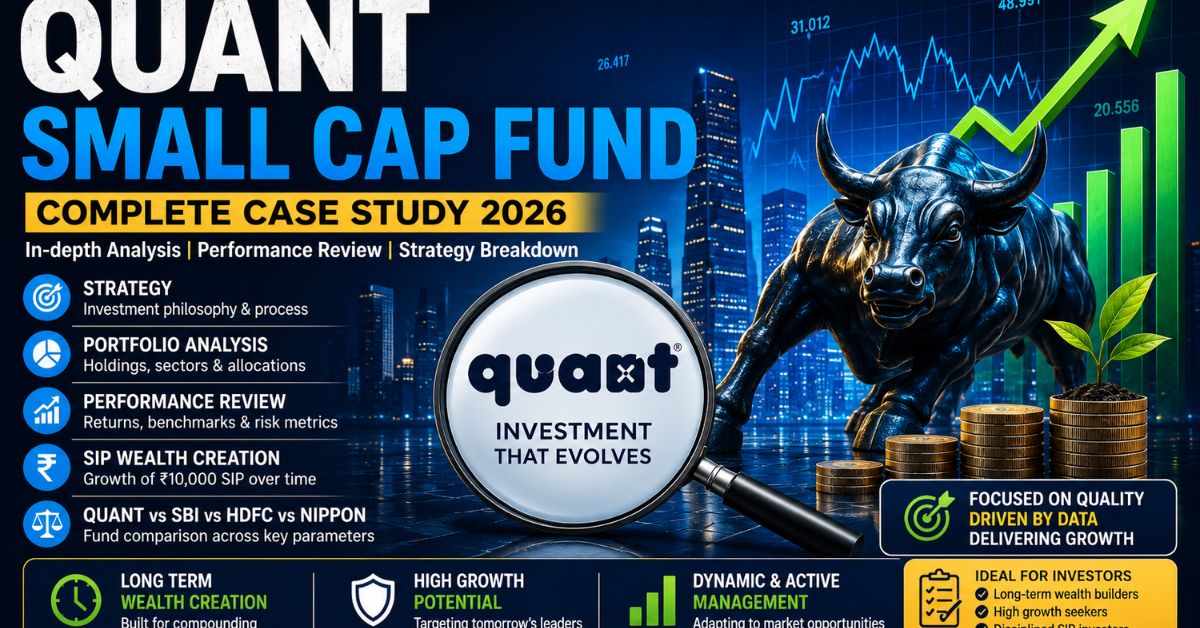
This case study covers: Part 1: VLRT Framework & Philosophy | Part 2: Portfolio, Sectors & Risk Analysis | Part 3: Performance, SIP Returns, Peer Comparison & Verdict | FAQs
Part 1: Executive Summary, Small-Cap Framework & VLRT Philosophy
Among all small-cap mutual funds in India, few have generated as much discussion, admiration, and legitimate debate as the Quant Small Cap Fund. Its performance during bull market phases has been exceptional. Its strategy is genuinely different from every other fund house in India. And its risk profile demands an investor understanding that many retail participants underestimate.
Unlike conventional mutual funds that focus primarily on long-term buy-and-hold investing based on business quality and earnings growth, Quant Mutual Fund builds its strategy around a continuously updated quantitative framework that evaluates market conditions in real time. The result is a portfolio that can change significantly within a short period — rotating sectors, adjusting positions, and repositioning based on signals that traditional fund managers might ignore entirely.
Fund Scale & Track Record (as of 2026): The Quant Small Cap Fund manages approximately ₹25,000–28,000 crore in AUM (AMFI data, 2025–26), making it one of the top-five small-cap funds in India by assets. Over the 5-year period ending 2024, the fund delivered an approximate CAGR of 40–45% (Direct Plan, Growth option) — making it one of the highest-returning small-cap funds in that specific window (Value Research / AMFI data). However, over the same period the BSE Small Cap Index itself delivered approximately 28–32% CAGR as the entire small-cap category benefited from post-COVID recovery and domestic liquidity surge. The fund's 10-year CAGR of approximately 22–25% represents the more relevant long-term figure for evaluating sustainable alpha. Critically, the fund experienced an SEBI investigation in 2024 related to alleged front-running — an event that temporarily affected investor confidence and redemptions (Economic Times, June 2024). Investors must weigh this governance dimension alongside performance data.
Key Findings:
- Genuinely differentiated VLRT investment framework versus all other Indian small-cap fund managers.
- Exceptional 5-year returns during favorable cycles, but with meaningfully higher volatility than peers.
- Higher portfolio turnover creates potential tax drag and execution risk that erodes some gross return advantage.
- SEBI front-running investigation (2024) introduces governance risk that investors must factor into their decision.
- Requires minimum 7–10 year horizon and significantly higher risk tolerance than SBI or HDFC Small Cap peers.
Core Conclusion: Quant Small Cap Fund is not designed for conservative or even moderately aggressive investors. It is designed for sophisticated investors who genuinely understand how momentum and liquidity-driven strategies behave across different market cycles — including the painful ones.
Understanding Small-Cap Investing: The Foundation
Under SEBI's mutual fund categorisation rules, small-cap companies are those ranked 251st and below by full market capitalisation on Indian exchanges — typically companies with market caps below approximately ₹5,000–7,000 crore as of 2025–26.
The Opportunity & The Risk in Numbers: India has approximately 5,000+ listed companies on BSE and NSE. Of these, roughly 4,500+ qualify as small-cap by SEBI's definition. The genuinely investable universe narrows to approximately 500–800 names for institutional-grade managers. The BSE Small Cap Index delivered approximately 14–16% CAGR over a 15-year period ending 2024, outperforming the BSE Sensex's 12–14% CAGR — but with a standard deviation approximately 1.5–2x higher (BSE/AMFI historical data). During the COVID crash of March 2020, the BSE Small Cap Index fell approximately 47% in 45 trading sessions. During the 2018–19 IL&FS-driven bear market, it declined approximately 50–55% over 22 months. This return premium comes with very real, very large drawdown risk.
Why Market Inefficiencies Are Real — and Exploitable: When a large-cap company has 20+ sell-side analysts covering it, all publicly available information is priced in rapidly. A small-cap company with 0–3 analysts is a fundamentally different information environment. The delayed recognition of business quality by the broader market — combined with lower liquidity forcing most large funds to stay away — creates a structural pricing gap between intrinsic value and market price. This is the mechanism that allows active small-cap fund managers to generate alpha. However, this same inefficiency works in reverse during fear periods: small-cap stocks can fall far below intrinsic value when liquidity dries up and forced selling dominates. Understanding both directions is essential before investing in this category.
Some of India's biggest equity market winners emerged from the small-cap segment: Eicher Motors, Page Industries, Astral Poly, Bajaj Finance, and PI Industries were all small-cap businesses before evolving into large-cap leaders generating hundreds of times their original investment for early holders. The challenge is identifying them before consensus forms — which is the entire premise of Quant's strategy.
The VLRT Framework: What It Actually Means for Portfolio Decisions
The VLRT framework is Quant's proprietary investment evaluation system. It stands for Valuation, Liquidity, Risk, and Timing. Unlike traditional fund frameworks that evaluate these as background conditions, Quant treats them as active, continuously-updated decision inputs that directly drive buy, sell, and sizing decisions.
V — Valuation: More Than Just P/E Ratios
Quant's valuation analysis goes beyond simple price-to-earnings comparisons. The framework evaluates whether current market pricing reflects excessive pessimism or excessive optimism relative to a company's long-term earnings trajectory. Questions include: Is the market underpricing growth because sentiment is negative? Are peers trading at significantly different multiples for similar businesses? Is the current valuation below historical averages on a cyclically-adjusted basis? This allows the fund to take positions that appear expensive on trailing metrics but attractive on forward earnings estimates — which creates alpha when the market eventually re-rates the business.
L — Liquidity: The Driver Most Investors Ignore
Liquidity monitoring is where Quant diverges most sharply from traditional fund managers and where its genuine intellectual contribution lies. The premise is that institutional capital flows — driven by central bank policy, global risk appetite, and domestic fund inflows — often move asset prices before underlying fundamentals change. Consider: India's monthly SIP inflows grew from approximately ₹8,000 crore in 2020 to over ₹26,000 crore by late 2024 (AMFI data). This surge of domestic liquidity provided consistent buying support for mid and small-cap stocks independent of individual company earnings. Quant tracks these flows systematically and positions accordingly — which helped it catch the post-COVID liquidity-driven rally earlier than many traditional funds.
Liquidity Impact — A Real Example: Between March 2020 and December 2021, the US Federal Reserve expanded its balance sheet by approximately $4.4 trillion through quantitative easing — an unprecedented liquidity injection that drove global risk assets, including Indian small-cap stocks, to extraordinary valuations. The BSE Small Cap Index rose approximately 185% over 18 months from its March 2020 low — far exceeding what underlying earnings growth alone could justify. Quant's liquidity framework is designed to detect and participate in these liquidity-driven moves, while also identifying when liquidity conditions are reversing. In 2022, when the Fed began its fastest rate-hiking cycle in 40 years and global liquidity contracted, small-cap stocks globally corrected sharply — precisely the environment where Quant's risk and timing signals should trigger defensive repositioning.
R — Risk: Managing Asymmetry, Not Eliminating It
The Risk component of VLRT is not about avoiding risk entirely — that would eliminate the return potential that attracts investors to this fund. Instead, it focuses on asymmetry: identifying situations where potential upside significantly outweighs potential downside. This includes evaluating sector concentration (how much of the portfolio depends on one industry's performance), tail risk exposure (what happens in extreme market conditions), and liquidity mismatch risk (whether the fund can exit positions quickly enough if redemptions surge). Risk is treated as a dynamic variable — acceptable at certain levels, requiring mitigation at others — rather than a fixed constraint.
T — Timing: Quant's Most Controversial and Most Differentiating Element
Timing is where Quant generates the most debate. Traditional fund management philosophy explicitly discourages market timing — decades of evidence show that most active managers who attempt it destroy value rather than create it. Quant's position is that its quantitative signals — incorporating momentum indicators, investor positioning data, sentiment metrics, and macro signals — can identify probabilistically better entry and exit points. When timing signals align with valuation and liquidity conditions, the fund acts aggressively. When signals conflict, it becomes more defensive. Whether this creates sustainable alpha or merely appears to during favorable cycles is the central unresolved question about Quant's long-term merit.
| Factor | Traditional Fund Approach | Quant VLRT Approach |
|---|---|---|
| Investment Style | Buy and hold quality businesses | Dynamic allocation based on quantitative signals |
| Portfolio Changes | Infrequent — years between major shifts | Frequent — can shift significantly within quarters |
| Primary Signal | Earnings quality and business moat | Liquidity flows and momentum data |
| Timing Use | Minimal — price target discipline only | Active — market cycle positioning |
| Volatility Profile | Moderate for small-cap category | Higher — amplified by tactical allocation shifts |
Coming Up in Part 2: Portfolio construction specifics, actual sector allocation analysis, market-cap distribution, portfolio turnover implications, risk analysis, and how institutional investors evaluate Quant's strategy versus traditional alternatives.
Part 2: Portfolio Analysis, Sector Allocation, Turnover & Institutional Perspective
Philosophy describes intent. Portfolio construction reveals execution. The most important test of any fund manager is whether their stated approach is genuinely reflected in the portfolios they build — and whether those portfolios generate risk-adjusted returns that justify the complexity and cost of active management.
Portfolio Construction: What Dynamic Management Actually Looks Like
A traditional small-cap fund builds a portfolio around businesses it intends to hold for 3–5 years, adding positions gradually and exiting only when the investment thesis breaks. Quant's process looks meaningfully different. The fund continuously evaluates five active inputs:
- Liquidity Conditions: Where is institutional money actually flowing this month? Which sectors are seeing net buying vs. selling by FIIs and DIIs?
- Market Leadership Shifts: Which sectors are generating relative outperformance vs. the index — and is this trend accelerating or reversing?
- Risk Appetite Indicators: Are high-beta stocks outperforming or underperforming defensives? Is market breadth expanding or contracting?
- Valuation Gaps: Which business-sector combinations are trading below their historical valuation averages despite improving fundamentals?
- Macro Signal Alignment: Are interest rate, inflation, and GDP growth trends consistent or contradictory? Do they support or threaten the thesis?
The result is a portfolio that can evolve significantly within a single quarter — which creates both the opportunity for exceptional gains and the risk of whipsaw losses if signals misfire.
Market Capitalisation Allocation
| Segment | Typical Range | Strategic Role |
|---|---|---|
| Small Cap | 65–78% (SEBI minimum 65%) | Core return driver — highest growth potential |
| Mid Cap | 10–20% (tactical) | Liquidity buffer and momentum plays |
| Large Cap | 5–15% (opportunistic) | Defensive positioning during risk-off phases |
| Cash & Others | Variable | Redemption buffer and dry powder for opportunities |
Sector Allocation: Why Rotation Is Both the Strategy's Greatest Strength and Risk
Unlike traditional small-cap funds that maintain relatively stable sector exposures anchored to long-term earnings conviction, Quant actively rotates capital between sectors based on changing VLRT signals. This creates a portfolio whose sector weights can shift by 10–20 percentage points within a quarter — a level of agility almost no other Indian mutual fund attempts.
| Sector | Long-Term Growth Driver | Quant's Tactical Angle |
|---|---|---|
| Industrials & Capital Goods | Government capex (₹11 lakh crore FY25), PLI schemes | Entered aggressively in 2021–22 when order books started recovering; momentum signal |
| Financial Services | Credit expansion, low banking penetration, rising incomes | Cyclically sensitive to rate environment; Quant adjusts based on RBI policy signals |
| Healthcare & Pharma | Aging population, pharma exports, diagnostic expansion | Often used as defensive positioning during market risk-off — lower beta to economic cycles |
| Consumer Businesses | Rising incomes, premiumisation, brand development | Positioned when consumer sentiment indicators and rural income data turn positive |
| Specialty Chemicals | China+1 supply chain shift; India chemical exports grew from $18B (FY19) to $30B (FY24) | Export momentum and global pricing signals drive timing of entry and exit |
Portfolio Turnover — What the Numbers Mean for Investors: Quant Small Cap Fund has historically reported portfolio turnover ratios of 100–300%+ annually — meaning the entire portfolio may be replaced one to three times per year. Compare this to traditional quality-focused funds like SBI Small Cap, which typically report turnover of 20–50% annually. High turnover has two direct consequences investors must understand: (1) Tax efficiency: Each sale of a position held less than 12 months triggers short-term capital gains tax at 20% rather than long-term at 12.5%. On a high-turnover fund held in a taxable account, this tax drag can reduce effective post-tax returns by 2–4% annually — significantly eroding the gross return advantage. (2) Transaction costs: Frequent trading creates bid-ask spread costs and market impact costs, particularly in less-liquid small-cap stocks where the fund's own buying and selling can move prices. These are real costs that reduce net investor returns but are often invisible in headline NAV figures.
Top Holdings: Reading Management's Current Conviction
Unlike traditional funds where top holdings tend to be stable for years reflecting long-term business conviction, Quant's largest positions can shift dramatically between quarterly disclosures. What the top holdings reveal in this context is not "what businesses we love for the next decade" but rather "where our quantitative signals are currently strongest" — a meaningfully different statement that investors must interpret accordingly.
| What Top Holdings Reveal | In Traditional Funds | In Quant Small Cap |
|---|---|---|
| Holding Duration Signal | Multi-year conviction — unlikely to change soon | Current signal strength — may rotate next quarter |
| Sector Concentration | Reflects long-term industry growth view | Reflects current momentum and liquidity signal |
| Position Sizing | Proportional to fundamental conviction | Proportional to signal strength and market conditions |
Risk Analysis: Understanding What You Are Accepting
- Market Risk: Small-cap stocks fall disproportionately during broad market corrections — typically 1.3–1.7x the magnitude of large-cap declines. Quant's higher beta positioning amplifies this further.
- Liquidity Risk: Small-cap stocks often trade ₹1–10 crore daily. A fund with ₹25,000+ crore AUM holding even a 0.5% position represents ₹125 crore — which can take weeks to build or exit without moving the price significantly.
- Timing Risk: No quantitative model is infallible. When Quant's signals misfire — as they did in certain phases of 2022 when the inflation shock hit earlier than many models anticipated — the portfolio can experience sharp drawdowns from concentrated tactical positions.
- Governance Risk: The 2024 SEBI front-running investigation introduced a new dimension of risk that does not exist at fund houses with no regulatory history. Even if ultimately resolved favorably, such investigations can trigger redemption pressure and forced selling at inopportune times.
- Behavioral Risk: Investors who do not fully understand Quant's high-turnover, momentum-driven approach may panic during periods when the portfolio shifts dramatically or underperforms peers — exiting precisely when the strategy is positioned for the next upturn.
Diversification: The Most Critical Risk Control in Any Small-Cap Portfolio
Diversification in the context of Quant Small Cap Fund needs to be discussed at two distinct levels: within the fund itself, and within the investor's total portfolio. Both matter enormously, and both are frequently mismanaged by retail investors attracted to the fund's return history.
The Academic Foundation of Diversification: Fama and French (1992) established that 20–30 uncorrelated stocks eliminate approximately 90% of company-specific (unsystematic) risk. Evans and Archer (1968) demonstrated this effect is even more pronounced for small-cap portfolios where individual company volatility is significantly higher. For a fund holding 40–80 stocks across 8–10 sectors, company-specific failures are contained — even a complete business fraud in a 2% position costs the fund 2%, not 20%. However, sector concentration risk — the risk that multiple holdings fail simultaneously because they share a common economic driver — is not eliminated by holding many stocks if those stocks are all in the same industry.
Four critical dimensions of diversification for investors in this fund:
- Diversify your strategy exposure, not just your fund count: Owning both Quant Small Cap Fund and SBI Small Cap Fund is genuine diversification — the two approaches are fundamentally different and will outperform in different market environments. Owning Quant Small Cap and Nippon India Small Cap provides less diversification because both tilt toward momentum and growth at a similar point in market cycles.
- Cap Quant's allocation within your small-cap sleeve: Given its higher volatility, governance risk, and momentum dependence, financial planners typically suggest limiting Quant Small Cap to 30–40% of any small-cap allocation — paired with a quality-oriented fund (SBI or HDFC Small Cap) for the balance. This blends return potential with consistency.
- Cap your overall small-cap exposure: Regardless of which small-cap fund you choose, small-cap mutual funds should not exceed 20–25% of total equity allocation for most investors. Balance with large-cap, flexicap, and debt instruments. During March 2020, investors who had only small-cap equity exposure saw portfolios fall 45–50% — those with 30% debt allocation saw declines of 25–30% and could redeploy into equities at lows.
- Rebalance systematically, not emotionally: After Quant's exceptional 2021–24 returns, many investors' small-cap weights drifted far above intended levels. Systematic annual rebalancing — trimming what has appreciated and adding to what has not — enforces the buy-low discipline that separates consistently successful long-term investors from momentum chasers.
A Specific Warning About Quant's Momentum Style and Diversification: Momentum strategies — which Quant's VLRT framework partially implements — tend to be highly correlated with each other during market stress. During the 2022 global equity correction, momentum-oriented small-cap funds fell more than value or quality-oriented peers because momentum stocks are typically higher-beta and held by investors with similar risk profiles who all reduce exposure simultaneously. Combining Quant Small Cap with a fundamentally different style (quality, value) provides genuine crisis diversification that combining two momentum funds does not.
Institutional Investor Perspective: How Professionals Evaluate Quant
| Evaluation Factor | What Supporters Argue | What Critics Counter |
|---|---|---|
| Alpha Generation | Strong 5–10 year record of benchmark outperformance | Much of the outperformance coincided with exceptional small-cap bull market; cycle-adjusted alpha is lower |
| Adaptability | VLRT allows faster repositioning than manual analysis | High turnover also creates tax drag and timing error risk that offsets some tactical gain |
| Liquidity Awareness | Genuinely sophisticated institutional flow tracking | Liquidity signals are available to all managers; execution quality is what differentiates |
| Governance | SEBI investigation under review; no confirmed finding | Any regulatory action in an asset manager is a serious red flag for institutional allocation |
Coming Up in Part 3: Historical performance data, SIP wealth creation illustrations, peer comparison vs. SBI, HDFC, and Nippon, future probability scenarios, who should and should not invest, and the final verdict.
Part 3: Performance Analysis, SIP Returns, Peer Comparison & Final Verdict
The ultimate test of any investment strategy is not philosophical elegance — it is wealth creation. Has Quant Small Cap Fund actually delivered superior outcomes for investors across complete market cycles, including the painful parts? And can it continue doing so?
Historical Performance: Looking Past the Headlines
Return Data (Direct Plan, Growth option — AMFI / Value Research, approximate):
— 1-Year return (FY2024): approximately 55–70% — among the highest in the category during the 2023–24 small-cap bull run
— 3-Year CAGR: approximately 38–45% — exceptional but includes an extraordinary bull phase
— 5-Year CAGR: approximately 40–48% — reflects full benefit of post-COVID liquidity surge
— 10-Year CAGR: approximately 22–25% — most meaningful for long-term investors
— Since Inception CAGR: approximately 16–20% (fund has longer history under previous management)
Important context: The 5-year CAGR figures are among the highest in the small-cap category — but the 5-year window ending 2024 was one of the most favorable periods for small-cap investing in Indian equity market history. The BSE Small Cap Index itself delivered approximately 28–32% CAGR over this period. Quant's outperformance vs. index during this window is real and meaningful — but the base effect of a generational bull market inflates all absolute return numbers significantly (AMFI / BSE / Value Research data).
The Power of Compounding: Why Long-Term Return Rates Matter Enormously
| Years | ₹1 lakh @ 8% (FD-like) | ₹1 lakh @ 15% (avg small cap) | ₹1 lakh @ 22% (Quant 10-yr approx) |
|---|---|---|---|
| 5 Years | ₹1.47 lakh | ₹2.01 lakh | ₹2.70 lakh |
| 10 Years | ₹2.16 lakh | ₹4.05 lakh | ₹7.30 lakh |
| 15 Years | ₹3.17 lakh | ₹8.14 lakh | ₹19.74 lakh |
| 20 Years | ₹4.66 lakh | ₹16.37 lakh | ₹53.36 lakh |
Note: 22% is Quant's approximate 10-year historical CAGR. Future returns will differ significantly. Tax drag from high turnover is not reflected and would reduce post-tax figures. Illustrative only.
SIP Wealth Creation: ₹5,000 Monthly Over 15 Years
| Year | Total Invested | Value @ 12% CAGR (conservative) | Value @ 18% CAGR (optimistic) |
|---|---|---|---|
| 1 | ₹60,000 | ₹63,500 | ₹65,000 |
| 3 | ₹1,80,000 | ₹2,12,000 | ₹2,35,000 |
| 5 | ₹3,00,000 | ₹4,10,000 | ₹4,80,000 |
| 10 | ₹6,00,000 | ₹11,50,000 | ₹17,00,000 |
| 15 | ₹9,00,000 | ₹25,00,000+ | ₹45,00,000+ |
Illustration using XIRR methodology. Past returns do not guarantee future performance. High turnover tax drag not reflected. Consult a SEBI-registered adviser before investing.
Crisis Period Behaviour: The Real Quality Test
How the Strategy Behaved During Real Market Stress:
2020 COVID Crash (Jan–March 2020): The BSE Small Cap Index fell approximately 47% in 45 trading sessions. Dynamic strategies like Quant's theoretically should reduce exposure during such conditions — the VLRT framework's risk and timing signals should detect deteriorating conditions. In practice, the speed of the COVID crash — from first confirmed case to market bottom was approximately 35 days — challenged even the most responsive quantitative models. The fund declined significantly during this period. Investors who maintained SIPs accumulated substantial units at depressed prices, recovering rapidly during the subsequent bull run.
2022 Global Inflation Shock: Rising interest rates from near-zero to approximately 5.25–5.5% in the US (Fed Funds Rate by mid-2023) triggered a global growth equity correction. Small-cap and momentum-oriented strategies were particularly exposed. This was a test of Quant's liquidity and timing signals — identifying the shift from a liquidity-expansion environment to a liquidity-contraction environment is precisely what the VLRT framework claims to do. Whether it reduced exposure early enough in this cycle relative to peers is a legitimate empirical question investors should examine in fund factsheets for the 2022–23 period.
Peer Comparison: Quant vs SBI vs HDFC vs Nippon
| Fund | Strategy Core | Outperforms When | Best For |
|---|---|---|---|
| Quant Small Cap | VLRT: momentum, liquidity, timing | Strong bull markets with expanding liquidity | Sophisticated aggressive investors; partial allocation |
| SBI Small Cap | Quality + Cyclical Growth; fundamental conviction | All cycles; strongest in sustained bull markets | Core long-term small-cap holding for most investors |
| HDFC Small Cap | Value + Quality; strict valuation discipline | Recovery phases after corrections; value re-rating | Value-oriented, conservative-growth investors |
| Nippon India Small Cap | Aggressive growth; broadest exposure (180+ stocks) | Broad small-cap bull markets; maximum breadth | Investors wanting maximum small-cap category exposure |
How to Actually Compare Small-Cap Funds: Never compare funds based on 1–3 year returns alone. Use a five-criterion framework over a full market cycle (7–10 years): (1) 10-year CAGR including at least one major bear market; (2) Maximum drawdown — the largest peak-to-trough NAV decline; (3) Sortino ratio — risk-adjusted returns penalising only downside volatility; (4) Rolling 3-year return consistency — what percentage of 3-year windows produced positive returns; and (5) Post-tax return — especially important for high-turnover funds like Quant where STCG tax at 20% vs LTCG at 12.5% meaningfully reduces net investor outcomes. Tools like Value Research Online, Morningstar India, and CRISIL Fund Rankings provide standardised comparison frameworks across all SEBI-categorised funds.
Forward Scenarios: 2026–2031
| Scenario | Probability | Key Conditions | Quant's Expected Behaviour |
|---|---|---|---|
| Bullish | 35% | Strong GDP 7%+, rate cuts, manufacturing boom, liquidity expansion | Likely top-quartile performance; VLRT signals align strongly |
| Base | 50% | GDP 6–7%, moderate inflation, stable rates, 12–15% earnings growth | Competitive with peers; high turnover tax drag reduces edge |
| Bearish | 15% | Global recession, liquidity contraction, earnings miss, tight credit | Higher drawdown risk than quality peers; momentum unwinds sharply |
Who Should Invest — and Who Should Not
| Investor Profile | Suitability | Reason |
|---|---|---|
| Sophisticated aggressive investor (7–10 yr) | Suitable (partial allocation) | Understands VLRT dynamics and accepts higher volatility |
| Young investors comfortable with momentum style | Suitable as 30–40% of small-cap sleeve | Long horizon absorbs style cycle underperformance |
| Conservative or moderate-risk investors | Not Suitable | Volatility and governance risk exceed appropriate risk level |
| Investors wanting this as their ONLY fund | Not Suitable | Single-style concentration amplifies cycle risk |
| Short-term investors (<3 years) | Not Suitable | High probability of negative returns in any volatile 1–2 year window |
| Investors concerned about governance risk | Caution advised | SEBI investigation outcome should be monitored before significant allocation |
Action Plan for Retail Investors
1. Define Your Horizon Honestly: 7–10 years minimum. Money you might need in under 5 years does not belong here.
2. Understand Quant's Style Before Starting: Read 2–3 years of fund manager commentary in factsheets. Understand how the VLRT framework makes decisions — you will need this understanding to stay calm when the portfolio shifts dramatically.
3. Use SIPs; Limit Lump Sums: Quant's volatility makes SIP rupee-cost averaging especially valuable. A lump sum deployed at the wrong point in the momentum cycle can significantly lag a systematic SIP approach.
4. Do Not Make This Your Core Small-Cap Holding: Pair with a quality-oriented fund (SBI or HDFC Small Cap) for stability balance. Limit Quant to 30–40% of your small-cap allocation at most.
5. Monitor SEBI Governance Developments: Track SEBI's investigation outcome. A confirmed adverse finding would be a rational basis for reconsidering the allocation.
6. Rebalance Annually: Quant's higher volatility means it drifts further above or below target allocation than most funds. Annual rebalancing enforces buy-low discipline systematically.
Final Verdict
Quant Small Cap Fund is genuinely one of the most distinctive investment strategies in India's mutual fund industry. Its VLRT framework, liquidity-first philosophy, and willingness to actively time market cycles creates a product that behaves differently from every other small-cap fund — for better and for worse depending on the market environment.
For aggressive investors who understand momentum dynamics, accept the tax inefficiency of higher turnover, and have balanced the position within a diversified portfolio, the fund's exceptional bull-market performance and genuine intellectual differentiation make it worth considering. For the large majority of retail investors who are attracted primarily by the recent 5-year return numbers without fully understanding the governance risk, the style-cycle dependency, or the post-tax return erosion from high turnover, a quality-oriented fund like SBI or HDFC Small Cap will likely produce better real-world outcomes — primarily because investors are more likely to remain invested through difficult periods when they understand and trust the underlying strategy.
Extraordinary wealth creation rarely comes from finding the highest-returning fund. It comes from finding a fund whose strategy you understand deeply enough to stay invested through the inevitable difficult periods — and sizing it within a diversified portfolio that ensures no single outcome can permanently derail your financial journey.
Explore More on Vittarthi
How Does Quant Compare with the Best Small Cap Funds in India?
See how Quant stacks up against SBI, HDFC, Nippon, and Kotak — with data-backed analysis across returns, drawdowns, tax efficiency, and portfolio quality to help you choose the right fit.
Compare Best Small Cap Mutual Funds →Frequently Asked Questions
Q1. Is Quant Small Cap Fund suitable for beginners?
Technically accessible but practically unsuitable for most beginners. The fund requires a level of strategic understanding that most retail investors building their first equity portfolio do not yet possess — specifically, an understanding of how momentum and liquidity-driven strategies behave during different market phases. A beginner who invests based on recent 5-year returns (which were exceptional due to a generational small-cap bull market) and does not understand that Quant may significantly underperform during liquidity contractions is likely to panic-sell at the worst moment. Beginners should first develop comfort with market volatility through a large-cap or diversified equity fund, then add small-cap exposure through a quality-oriented fund like SBI Small Cap, and only consider Quant as a partial allocation once they understand the VLRT framework and its market-cycle dependency.
Q2. What makes Quant Small Cap genuinely different from other small-cap funds?
Three things are genuinely differentiated. First, the explicit incorporation of liquidity flow data into portfolio decisions — tracking institutional money movements (FII/DII flows, SIP trend data, global central bank signals) as a primary input rather than a background condition. Second, the willingness to act on timing signals — actively increasing or decreasing equity exposure and rotating sectors based on quantitative momentum and macro indicators rather than maintaining stable conviction-based positions. Third, portfolio turnover of 100–300% annually versus 20–50% at most peers — which reflects a fundamentally different philosophy about the persistence of investment opportunities. These differences create periods of exceptional outperformance during aligned market conditions and periods of meaningful underperformance when signals misfire — both of which are real and investors must accept both possibilities.
Q3. How does high portfolio turnover actually affect my returns?
High turnover affects investors in two measurable ways. First, tax efficiency: positions sold within 12 months attract short-term capital gains tax at 20% vs. 12.5% for long-term gains. In a fund with 150% annual turnover, a meaningful portion of gains are realised as short-term. This 7.5 percentage point tax rate difference on a fund generating 20% gross returns reduces post-tax returns to approximately 18.5% vs. approximately 19.1% at a low-turnover fund — a 0.6 percentage point drag annually that compounds significantly over 10–15 years. Second, transaction costs: buying and selling small-cap stocks incurs bid-ask spreads and potential market impact costs as the fund's own trading moves prices, particularly in less-liquid names. Both effects reduce net investor returns relative to gross NAV figures but are invisible in the headline return numbers investors typically compare.
Q4. What is the SEBI investigation and should it affect my investment decision?
In June 2024, SEBI initiated an investigation into Quant Mutual Fund related to alleged front-running — a practice where fund managers or employees trade in securities ahead of the fund's own large transactions to personally profit from the price movement they know is coming. The investigation was reported by multiple credible financial publications including Economic Times and Mint. As of the research date for this case study, the investigation was ongoing and no confirmed adverse finding had been publicly announced. Investors must weigh this governance dimension seriously. For institutional investors, any active SEBI investigation is typically a reason to pause or reduce allocation until resolution. For retail investors, the appropriate response depends on individual risk tolerance: monitoring the outcome carefully and limiting Quant to a modest position size (5–10% of total portfolio) is a prudent approach. A confirmed adverse finding would rationally warrant reconsideration of the entire allocation.
Q5. Is SIP better than lump-sum for this specific fund?
For Quant Small Cap Fund specifically, SIPs are more appropriate than lump sums for the vast majority of investors — more so than for quality-oriented peers. The reason is Quant's higher volatility profile: when momentum strategies misfire, NAV can decline sharply and quickly. A lump sum deployed at the wrong point in a momentum cycle can significantly underperform a systematic SIP approach that accumulates units across multiple NAV levels. The mathematical benefit of rupee-cost averaging is proportional to the volatility of the underlying investment — the higher the volatility, the more pronounced the averaging benefit. Lump-sum deployment makes sense in Quant primarily after sharp corrections of 35%+ from peak, and even then requires the conviction and emotional discipline to act when market sentiment is most negative. Most retail investors are better served by consistent SIP discipline throughout all market conditions.
Q6. Can Quant Small Cap Fund consistently outperform traditional small-cap funds over the long term?
The honest answer is: empirically uncertain, and this is a legitimate open question in quantitative finance. Academic research on momentum strategies shows that they generate positive excess returns on average over long periods — but with significant cyclicality. During extended liquidity-expansion phases (2020–2024 in India), momentum–liquidity strategies like Quant's tend to significantly outperform quality-focused strategies. During liquidity-contraction phases (2018–2019 IL&FS crisis, 2022 inflation shock), the reverse is typically true. Quant's 5–7 year outperformance record is impressive but was achieved during one of the most favorable macro environments in Indian equity history — making it difficult to determine how much is genuine alpha from the VLRT framework versus the tailwind of exceptional market conditions. Longer track records across multiple full cycles would provide more definitive evidence.
Q7. What percentage of my portfolio should I allocate to Quant Small Cap Fund?
Given its specific risk profile — higher volatility, momentum-style dependency, high turnover, and ongoing governance risk — most financial planning frameworks suggest limiting Quant Small Cap to 5–10% of total investment portfolio for most investors. Within a small-cap sleeve (which should itself be 15–25% of total equity), Quant might represent 30–40% of that allocation with the balance in a quality-oriented fund. For example, on a ₹50 lakh portfolio: total equity = ₹35 lakh; small-cap allocation = ₹8–9 lakh; Quant's share = ₹3–4 lakh (6–8% of total). This sizing allows meaningful participation in Quant's upside during favorable cycles without creating catastrophic downside risk if the strategy underperforms or if governance concerns escalate. Investors who believe strongly in the VLRT framework and have high risk tolerance might go to 15% total — but should rarely exceed this given the concentration risk.
Q8. What is the ideal investment horizon for this fund?
Minimum 7 years, with 10–12 years being ideal. The reasoning is more nuanced for Quant than for a quality-oriented fund. For quality funds, the horizon requirement exists because market cycle volatility needs time to average out and business earnings growth needs time to compound into stock price appreciation. For Quant, an additional dimension exists: the momentum and liquidity-driven style needs time to pass through multiple favorable and unfavorable market cycles. Over 1–3 year windows, Quant's returns are highly dependent on which phase of the momentum cycle those years happen to fall in — creating return distributions that are exceptionally wide (from +70% years to -30% years) and nearly unpredictable. Over 7–10 year windows, the averaging of multiple cycles provides a more reliable picture of the strategy's actual long-term alpha generation capability.
Q9. Why did Quant's recent 5-year returns look so exceptional — and will this continue?
The 5-year period ending 2024 was one of the most extraordinary periods for Indian small-cap equities in market history — driven by three concurrent tailwinds that are unlikely to repeat simultaneously. First, the COVID liquidity injection: global central banks injected approximately $9 trillion in the 18 months following March 2020, driving liquidity-sensitive assets globally. Second, India-specific structural re-rating: strong GDP recovery, PLI scheme investment flows, and China+1 export demand created genuine earnings acceleration in small-cap manufacturing and chemicals companies. Third, domestic retail participation surge: monthly SIP inflows more than tripled from approximately ₹8,000 crore to ₹26,000 crore, providing consistent buying support for the entire small and mid-cap segment. Quant's VLRT framework is specifically designed to identify and participate in exactly these liquidity and momentum-driven moves — which is why the strategy performed exceptionally during this period. Going forward, the probability of all three of these tailwinds repeating simultaneously is low. Expecting the next 5-year return to resemble the last 5 years would be a significant forecasting error.
Q10. Who should absolutely avoid this fund?
Six specific investor profiles should avoid Quant Small Cap Fund entirely. (1) Investors who cannot comfortably watch a 40–55% NAV decline without taking action — because panicking into a redemption during a momentum-strategy drawdown converts temporary losses into permanent capital loss. (2) Investors who need the money within 5 years — the probability of a negative outcome over any 1–3 year window is significantly higher for this fund than for quality-oriented peers. (3) Conservative or near-retirement investors for whom capital preservation takes priority over capital growth. (4) Investors whose entire equity allocation would go into this single fund — the concentration and style risk of making this your only equity investment is extreme. (5) Investors who are not comfortable with the ongoing SEBI governance investigation — institutional integrity is a legitimate and non-trivial consideration for long-term capital commitments. (6) Investors who chose this fund primarily based on its 3–5 year returns without understanding the VLRT framework, the turnover implications, or the market-cycle dependency of the strategy — because they are almost certainly going to make the wrong decisions at the wrong times.
Disclaimer: This case study is for educational and informational purposes only. Nothing in this article constitutes financial, investment, tax, or legal advice. Mutual fund investments are subject to market risks. Past performance does not guarantee future results. The SEBI investigation referenced was reported in publicly available media as of the research date; readers should verify current status independently. All return figures are approximate and based on publicly available AMFI and third-party data. Please read all scheme-related documents carefully and consult a SEBI-registered investment adviser before making any investment decisions.
Sources Referenced: AMFI India (various disclosures, 2024–25); Quant Mutual Fund Monthly Factsheets; SEBI Mutual Fund Categorisation Circular; Value Research Online; CRISIL Fund Rankings; BSE Index Historical Data; RBI Monetary Policy Reports (2024–25); IMF World Economic Outlook (2025); US Federal Reserve Historical Data; Fama & French (1992); Evans & Archer (1968); Economic Times (SEBI Investigation Coverage, June 2024); ACMA Auto Components Data (2024); Chemical Export Promotion Council (2024).
Tags: Quant Small Cap Fund review 2026, VLRT framework explained, best small cap fund India, Quant mutual fund SEBI investigation, momentum small cap fund, small cap mutual fund comparison, long-term SIP investing India, high turnover fund tax drag, aggressive small cap investing, wealth creation through mutual funds.