
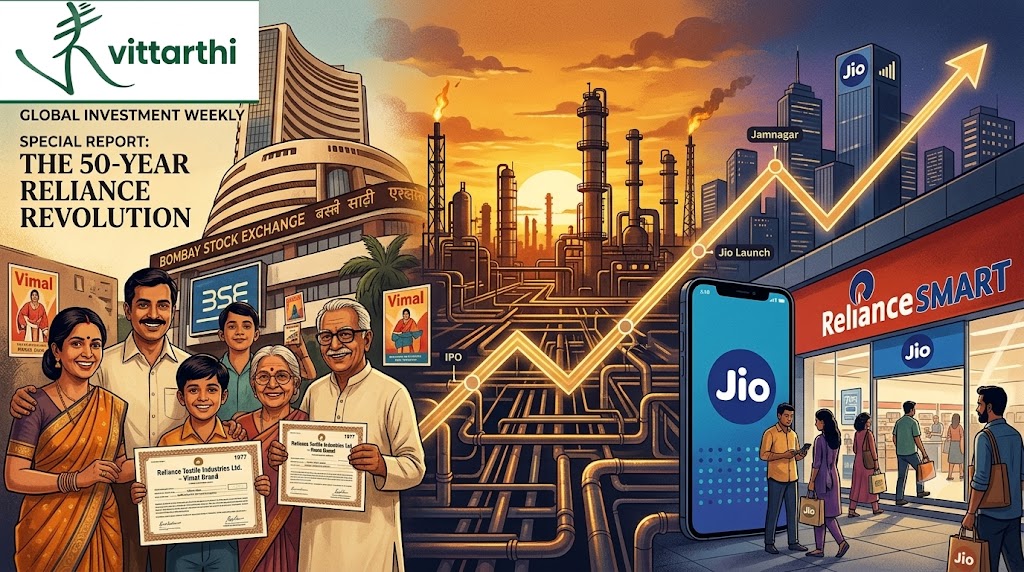
How Reliance Created
Generational Wealth
The complete 50-year investment case study — from a modest textile trading operation to one of Asia's largest conglomerates, and what it teaches long-term investors.
The Foundations
How a modest trading firm laid the groundwork for India's most valuable conglomerate
Executive Summary
Few companies in global stock market history have created wealth on the scale achieved by Reliance Industries. From a small trading operation started with modest capital in the 1960s, Reliance evolved into one of the largest business empires in Asia, expanding from textiles into petrochemicals, refining, oil and gas, retail, telecommunications, digital platforms, and renewable energy.
Over multiple decades, Reliance rewarded long-term investors through several interconnected mechanisms:
- Massive capital appreciation — RIL's share price has compounded at a rate that far exceeds most peer Indian industrials over 40+ years
- Bonus shares — multiple rounds of bonus issuances multiplied share counts for patient holders
- Rights issues at preferential prices — allowing existing shareholders to participate in growth capital
- Consistent dividends — even through capital-intensive phases
- Business expansion into new industries — each creating fresh valuation triggers
For many Indian families, ownership of Reliance shares became a source of intergenerational wealth — held across two or even three generations.
India Before Reliance: The License Raj Context
To understand Reliance's rise, investors must first understand the India of the 1960s and 1970s. The economy was dramatically different from today, characterized by low foreign investment, heavy state regulation, restricted imports, and an underdeveloped capital market.
This period is often described as the "License Raj" — where government approvals controlled much of industrial activity. Building a large private enterprise during this era was extraordinarily difficult. Yet this environment also created opportunities for entrepreneurs willing to think differently.
| Economic Factor | Situation in 1960s–70s India |
|---|---|
| GDP Growth | Relatively low — the "Hindu rate of growth" (~3.5% annually) |
| Foreign Investment | Severely limited by FERA and capital controls |
| Private Enterprise | Highly regulated — industrial licensing required for most activities |
| Imports | Restricted to protect domestic industry |
| Capital Markets | Underdeveloped; retail equity ownership was rare |
| Consumer Demand | Emerging, with rapid urbanization underway |
The Early Life of Dhirubhai Ambani
Born in Chorwad, Gujarat, Dhirubhai Ambani did not come from a wealthy industrial family. Unlike many business leaders of his generation, he began with limited formal education and scarce resources. His early experiences working in Aden (Yemen) in commodity trade and import-export exposed him to international market dynamics, supply chain realities, and the economics of arbitrage — experiences that would prove foundational.
What distinguished Dhirubhai was not access to capital or family connections. It was his understanding of scale as a strategic weapon — the idea that building at a size your competitors cannot replicate creates a permanent advantage. Where many entrepreneurs accepted the limitations of the License Raj environment, he searched for ways to work within and around them.
"Think big, think fast, think ahead. Ideas are no one's monopoly."
— Dhirubhai Ambani (widely attributed in multiple documented speeches)The Birth of Reliance
Reliance Commercial Corporation was founded in 1966, initially operating as a textile yarn trading business. The early focus was simple: source yarn, find buyers, earn a margin. But management quickly identified a critical lesson: the largest wealth is often created by moving up the value chain.
Rather than remaining a trader — dependent on suppliers, vulnerable to margin compression — Reliance began building manufacturing capabilities. This single strategic decision would change the trajectory of the company permanently.
Why Manufacturing Changed Everything
Trading generates profits. Manufacturing creates scale. Reliance understood four economic realities that most competitors underestimated at the time:
The Textile Revolution: Building a Consumer Brand
Reliance's entry into textiles through its Vimal brand demonstrated a sophisticated understanding of Indian consumer behavior. While most textile manufacturers competed on price, Reliance invested in mass advertising, nationwide distribution, and brand identity — creating pricing power that pure commodity producers could not access.
This distinction matters deeply from an investment perspective. Strong brands command:
- Better pricing power — reducing vulnerability to commodity cycles
- Higher customer loyalty — creating repeat revenue and lower customer acquisition costs
- Stronger gross margins — allowing reinvestment without diluting shareholders
- Long-term competitive advantages that are difficult to replicate quickly
This capability for consumer brand building would resurface as a defining strength decades later when Reliance entered retail and digital services.
The Strategic Vision: Building Interconnected Ecosystems
One of the most important lessons from Reliance's history is strategic integration. Rather than operating isolated businesses, management continuously asked: "What is the next link in the value chain that we should own?"
This led to a deliberate expansion path: textiles → synthetic fibers → petrochemicals → polymers → refining → energy. Each new business strengthened existing operations rather than diluting focus — a hallmark of well-managed vertical integration.
What Made Reliance Different
Management consistently invested in capacity ahead of demand — a high-risk, high-reward strategy that required both capital and conviction. While competitors expanded cautiously, Reliance built for the market it expected to exist, not the one that currently existed.
Reliance would later revolutionize shareholder participation in India — recognizing that public markets could be a powerful, low-cost growth engine when investor trust is cultivated deliberately.
Rather than relying heavily on external suppliers, Reliance gradually integrated operations across the value chain — delivering lower costs, better efficiency, greater margins, and structural competitive advantages that compounded over decades.
Management frequently made investments whose benefits would only become visible years — sometimes a decade — later. This long-term thinking created compounding effects that short-term-oriented competitors were structurally unable to replicate.
Early Wealth Creation Signals
Long before Reliance became India's largest company, several indicators suggested exceptional potential — the same categories institutional investors screen for today:
| Signal | What It Looked Like at Reliance |
|---|---|
| Industry Expansion | Textiles and synthetics experiencing strong demand growth driven by urbanization |
| Management Ambition | Leadership pursuing national-scale opportunities, not regional increments |
| Scale Economics | Larger plant sizes enabling meaningful cost-per-unit advantages over smaller peers |
| Capital Efficiency | Demonstrated ability to reinvest profits into projects yielding high returns |
| Strategic Adaptability | Entering emerging industries before they became mainstream investor consensus |
Investor Lessons from the Early Reliance Story
Part 1 Conclusion
The foundations of Reliance's extraordinary wealth creation story were established long before it became India's largest company. The company's rise was built upon entrepreneurial vision, manufacturing expansion, brand creation, strategic integration, and long-term capital allocation.
The greatest compounders share one trait: the ability to continuously reinvent themselves while maintaining a relentless focus on growth.
The IPO That Changed Indian Investing Forever
How Dhirubhai Ambani brought ordinary Indians into the wealth creation journey — and why that decision transformed Indian capital markets
The first phase of Reliance's story was about entrepreneurship, manufacturing, and vision. The second phase was about something equally revolutionary: bringing ordinary Indian households into the equity wealth creation journey.
During the 1970s and early 1980s, equity investing in India was largely limited to institutions, wealthy families, and a small group of informed investors. Middle-class households predominantly held their savings in fixed deposits, gold, real estate, and government savings schemes. Dhirubhai Ambani saw an opportunity where others saw only risk.
The Reliance IPO: 1977
In 1977, Reliance Textile Industries went public on the Bombay Stock Exchange. The IPO was structured to attract retail investors at a time when most companies raised capital almost exclusively from development financial institutions. Dhirubhai invested heavily in investor education and outreach, holding shareholder meetings attended by tens of thousands across India.
Why this mattered: By treating shareholders as long-term partners rather than mere capital providers, Reliance built something unusual — a loyal, emotionally invested shareholder base that supported future capital raises at favorable terms. This gave the company a structural funding advantage over competitors that relied solely on institutional and bank debt.
How Wealth Creation Actually Happens
Most investors focus only on stock price appreciation. True wealth creation — particularly across generational timeframes — comes from multiple reinforcing mechanisms working simultaneously:
| Wealth Creation Driver | Mechanism | Long-Term Impact |
|---|---|---|
| Share Price Growth | Earnings growth + valuation re-rating | High |
| Bonus Shares | Capitalisation of reserves into shares | Very High |
| Rights Issues | Preferential allotment to existing holders | High (if exercised) |
| Dividends | Cash distribution of profits | Moderate (on growing cost base) |
| Business Expansion | New segments creating valuation step-ups | Extremely High |
Understanding Bonus Shares: A Compounding Engine
Bonus shares are additional shares issued to existing shareholders without requiring additional investment — funded from the company's accumulated reserves. While the share price typically adjusts downward on the bonus date, long-term holders who hold through multiple bonus cycles see their share count — and therefore their total economic ownership — multiply dramatically.
| Stage | Shares Owned | Change |
|---|---|---|
| Initial Purchase | 100 | Baseline |
| After 1:1 Bonus | 200 | +100% |
| After 2nd Bonus | 400 | +300% |
| After 3rd Bonus | 800 | +700% |
Note: This table is illustrative. Actual bonus history, ratios, and record dates are available in RIL's corporate action history on BSE.
The Reliance Wealth Creation Flywheel
By the 1980s, Reliance had created a self-reinforcing cycle — a flywheel that accelerated wealth creation for both the company and its investors:
Reliance vs. Typical Indian Businesses of the Era
| Metric | Typical Business | Reliance |
|---|---|---|
| Expansion Speed | Moderate, demand-driven | Aggressive, ahead of demand |
| Market Ambition | Regional / category-specific | National, then global |
| Capital Market Usage | Primarily bank debt | Public equity + debt, retail-oriented |
| Shareholder Engagement | Minimal | Industry-leading (mass AGMs) |
| Vertical Integration | Limited, outsourced inputs | Aggressive, full value chain |
Investor Lessons from the IPO Era
Part 2 Conclusion
The Reliance IPO was more than a fundraising event. It represented a turning point in Indian investing culture. By bringing ordinary investors into its growth journey, Reliance helped create one of the largest shareholder communities in the country — transforming equity investment from an elite pursuit to a mainstream activity.
Capital markets can be used not merely to finance growth, but to create a genuine partnership between entrepreneurs and long-term investors.
Building a Petrochemical Empire
How vertical integration, Jamnagar, and disciplined capital allocation transformed Reliance into one of India's most valuable industrial enterprises
By the mid-1980s, Reliance had already established itself as one of India's fastest-growing companies. However, the most important phase of wealth creation was still ahead. Many companies achieve success in one industry. Very few successfully transform themselves multiple times without losing strategic coherence.
Reliance's next transformation — from textiles to petrochemicals and refining — would fundamentally change its future and significantly increase its wealth creation potential. This was the phase when Reliance evolved from a successful manufacturing company into a large-scale industrial powerhouse operating at global scale.
The Strategic Question That Changed Everything
"Why buy raw materials from others when we can manufacture them ourselves?"
This question triggered one of the most important strategic shifts in Indian corporate history. By moving upstream into polyester, fibers, chemicals, petrochemicals, and feedstock production, Reliance simultaneously reduced costs, increased margins, and built barriers that competitors could not easily replicate.
Understanding Vertical Integration as a Moat
| Advantage | Business Impact | Investor Relevance |
|---|---|---|
| Lower Input Costs | Internal transfer pricing replaces market prices | Higher gross margins vs. peers |
| Supply Security | No dependency on external suppliers | More predictable earnings |
| Scale Benefits | Larger capacity = lower cost per unit | Structural cost advantage |
| Entry Barrier | Capital intensity deters new entrants | Durable competitive moat |
Why Petrochemicals Were a Massive Opportunity
India's industrial economy was expanding rapidly. Demand was increasing across plastics, packaging, consumer products, industrial materials, and synthetic fibers — all of which required petrochemical inputs. Reliance recognized that this market would grow for decades, and positioned itself not at the edge of the value chain but at its center.
The strategic logic was compelling: if you control the feedstock, you can price your downstream products competitively in any market environment. Competitors sourcing inputs from the open market would always be structurally disadvantaged during price spikes.
Capital Allocation: The Hidden Driver of Wealth
One of the most overlooked aspects of Reliance's success was capital allocation discipline. Many companies generate profits. Few deploy those profits into projects that generate superior future returns. Reliance's reinvestment cycle worked as follows:
The Jamnagar Vision: Building for Future Demand
Perhaps no project symbolizes Reliance's ambition and foresight more than the Jamnagar complex in Gujarat. Today it is recognized as one of the world's largest integrated refining and petrochemical hubs, with combined crude processing capacity exceeding 1.2 million barrels per day as of the mid-2010s — a figure that would have seemed implausible when the project was first conceived.
When the project was announced, many observers questioned its scale. Management, however, recognized that energy demand would increase, industrial activity would expand, and refining capacity would remain strategically critical for decades. Instead of building for present demand, Reliance built for future demand.
Investment insight: Jamnagar is a textbook example of investing ahead of the curve. The willingness to commit enormous capital to a project whose full returns would take a decade to materialise required both exceptional management conviction and a shareholder base with the patience to hold through the construction phase. This is a pattern that repeats across Reliance's history — and one that short-term-oriented competitors simply cannot replicate.
Scale as a Structural Competitive Advantage
Scale is not merely about size — it creates specific, quantifiable economic advantages. Consider two hypothetical producers in the same industry:
| Metric | Smaller Producer | Scale Producer (Reliance-type) |
|---|---|---|
| Production Capacity | 1 million units/year | 10 million units/year |
| Cost Per Unit | ₹100 | ₹80 (structural advantage) |
| Operating Margin | 10% | 20% (2x the margin at scale) |
| Market Share | 5% | 30%+ (pricing dominance) |
This table is illustrative of the general principle of scale economics. Actual RIL financials are available in BSE-filed Annual Reports.
How Institutions Evaluated Reliance
By the 1990s and early 2000s, Reliance increasingly attracted institutional attention from both domestic and foreign investors. Professional investors evaluate businesses across several dimensions — and Reliance scored strongly on each:
A Note on Diversification
Reliance's expansion from textiles into petrochemicals and then refining is sometimes described simply as "diversification." But this framing misses the strategic logic. These moves were not conglomerate diversification for its own sake — they were backward integration along the same value chain.
True diversification (entering unrelated industries) was a later phase of Reliance's story — retail, telecom, and digital services — where the logic shifted from value-chain ownership to ecosystem building. Investors should distinguish between these two types of expansion when evaluating any conglomerate's strategy.
Risks Faced During This Period
The journey was not without risk. Large industrial projects carried substantial execution challenges that any investor in capital-intensive businesses should understand:
- Execution risk: Major projects of Jamnagar's scale require precise multi-year implementation. Cost overruns and delays were real possibilities.
- Commodity cycles: Energy and chemical markets are inherently volatile. Margin compression during downturns can be severe for producers with high fixed costs.
- Regulatory risk: Industrial sectors face frequent policy changes, particularly in India where energy policy has historically been politically sensitive.
- Capital requirements: Large investments require substantial long-term funding — creating balance sheet risk if growth assumptions prove too optimistic.
Investor Lessons from the Petrochemical Era
Frequently Asked Questions
In theory, yes — the industries were open to competition and the capital markets were accessible. In practice, no — because the combination of Dhirubhai Ambani's specific understanding of scale economics, his willingness to invest ahead of demand, and his ability to build retail shareholder trust simultaneously was exceptionally rare. Structural factors alone do not explain Reliance; management quality was the decisive variable.
Not always in the short term. Large capital investments in petrochemicals and refining had long payback periods, and some phases involved significant debt. The key was that management executed each project at sufficient scale to achieve cost competitiveness once operational — and maintained the balance sheet discipline to survive the ramp-up phase. Investors who evaluated the business only on near-term earnings metrics repeatedly underestimated future returns.
The petrochemical and refining moves were backward integration — moving up the same value chain to capture more margin from the same end markets. The retail and telecom moves were horizontal diversification into entirely new customer segments. Both created value, but through different mechanisms. The earlier moves created margin expansion; the later moves created new addressable markets. Both are legitimate strategies, but they carry different risk profiles and require different management capabilities.
The signals at Reliance's early stage were not hidden — they included aggressive capacity expansion, high management ambition, strong investor-shareholder alignment, and operations in industries with long structural tailwinds. The challenge is conviction: acting on these signals requires holding through years of market indifference and short-term volatility. The investors who created the most wealth from Reliance were not those who identified it earliest — they were those who held longest.
The main risks in capital-intensive, vertically-integrated businesses are: (1) execution failure on large projects leading to cost overruns and delays; (2) leverage risk if the balance sheet becomes too stretched during construction phases; (3) commodity cycle exposure, particularly for energy and chemical businesses; and (4) regulatory risk in policy-sensitive sectors. Reliance managed all four effectively over decades — but investors should not assume this is the norm. Verify each before investing.
Part 3 Conclusion
The petrochemical and refining era marked one of the most important chapters in Reliance's history. Through vertical integration, large-scale investments, and disciplined capital allocation, the company transformed itself into one of India's most important industrial enterprises — operating at a scale and with an efficiency that competitors struggled to approach.
This period demonstrated a recurring pattern that investors should commit to memory: the greatest wealth creators often expand beyond their original business model and continuously reinvest in future growth opportunities — even when those future returns are invisible to the market at the time of investment.
Reliance's willingness to think at scale, invest aggressively, and integrate strategically created the foundation for the next wave of shareholder value — one that would involve a young India, a smartphone revolution, and the largest retail network in the subcontinent.
Part 4: Jio, Reliance Retail & The Consumer Empire
How Mukesh Ambani's leadership transition, the ₹1.5 lakh crore Jio disruption, and the creation of India's largest retail network generated an entirely new wave of shareholder value.