
Written by: Vittarthi Research Desk | Dedicated to analysing mutual funds, stocks, ETFs, and market trends through data-driven research and publicly available financial disclosures.
Reviewed by: Vittarthi Editorial Team | Factual accuracy using official fund house documents, AMFI disclosures, SEBI guidelines, portfolio reports, and historical performance data available in the public domain.
This case study covers: Part 1: Small-Cap Framework & Fund Overview | Part 2: Portfolio, Sectors & Holdings | Part 3: Performance, SIP Returns, Peer Comparison & Verdict | FAQs
Part 1: Executive Summary & Small-Cap Investing Framework
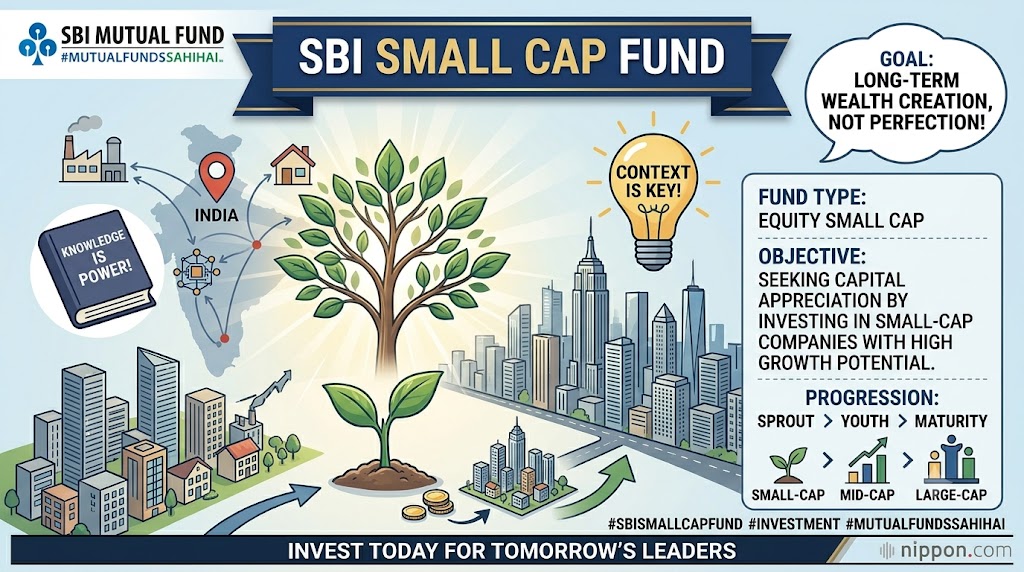
Finding the next generation of wealth-creating companies is one of the most challenging tasks in investing. While large-cap companies provide stability and predictability, small-cap businesses often offer the highest growth potential because they are still in the early stages of their growth journey — before institutional coverage widens, before analyst consensus forms, and before the market fully prices in their future earnings power.
Over the past two decades, many of India's biggest stock market winners initially emerged from the small-cap universe before evolving into mid-cap and large-cap leaders. The SBI Small Cap Fund was created to systematically identify such opportunities and give investors diversified, professionally managed exposure to India's growing small-cap ecosystem.
Fund Scale & Track Record (as of 2026): The SBI Small Cap Fund manages over ₹37,000 crore in AUM, making it one of India's largest small-cap mutual funds by assets (AMFI data, 2026). The fund has delivered a 10-year CAGR of approximately 18–20% (Direct Plan, Growth option) vs. the BSE 250 SmallCap TRI benchmark's ~15–17% over the same period — representing meaningful alpha generation across a full market cycle that included the 2018 IL&FS crisis, the 2020 COVID crash (where the BSE Small Cap Index fell ~47% in 45 trading days), and the subsequent recovery (Value Research / AMFI data). It maintains exposure across manufacturing, financial services, auto components, chemicals, consumer businesses, and capital goods.
Key Findings:
- Strong 10-year track record with consistent outperformance vs. benchmark across multiple market cycles.
- Large, diversified portfolio across 10+ sectors reduces single-business and single-sector concentration risk.
- Professional risk management with disciplined valuation framework and position sizing controls.
- Volatility is significantly higher than large-cap funds — drawdowns of 40–55% during crisis periods are expected for the small-cap category.
- Requires a minimum 7–10 year investment horizon; returns over shorter periods are highly unpredictable.
Core Conclusion: The SBI Small Cap Fund is not designed for short-term investing. Its real value lies in helping disciplined investors participate in the growth of India's emerging businesses over periods of 7 to 15 years or longer.
Understanding Small-Cap Investing: What SEBI's Definition Means for You
To understand this fund, investors must first understand the small-cap segment itself. Under SEBI's mutual fund categorisation circular, small-cap companies are those ranked 251st and below by full market capitalisation on Indian exchanges. As of 2025–26, this typically covers companies with market caps below approximately ₹5,000–7,000 crore — though this boundary shifts as broader markets move.
The Scale of India's Small-Cap Opportunity: India has approximately 5,000+ listed companies on BSE and NSE. Of these, roughly 4,500+ qualify as small-cap by SEBI's definition. However, the genuinely investable universe — businesses with adequate liquidity, governance standards, audited financials, and trackable earnings — narrows to approximately 500–800 names for institutional-grade fund managers. The BSE Small Cap Index has delivered approximately 14–16% CAGR over a 15-year period ending 2024, outperforming the BSE Sensex's 12–14% over the same horizon — but with a standard deviation roughly 1.5–2x that of the Sensex (BSE/AMFI historical data). This return premium for bearing additional volatility is the mathematical basis of the small-cap investing thesis.
| Factor | Small-Cap Companies | Large-Cap Companies |
|---|---|---|
| Growth Potential | Very High — early-stage scaling | Moderate — mature businesses |
| Analyst Coverage | Limited — creates pricing inefficiency | Extensive — prices efficiently reflect data |
| Volatility | High — sharp rallies and corrections | Lower — deeper institutional support |
| Liquidity | Lower — thin daily trading volumes | High — easy to buy and sell at scale |
| Market Share | Still developing and expanding | Established — harder to grow faster |
| Risk Level | High — business + liquidity risk | Lower — more predictable outcomes |
Why Limited Analyst Coverage Creates Genuine Investment Opportunity: When a large-cap company is tracked by 20+ sell-side analysts at major brokerages, all publicly available information is rapidly priced in — finding an informational edge is extremely difficult. A small-cap company covered by 2–3 analysts, or none at all, is a different environment entirely. A skilled fund manager who meets management directly, studies competitors, speaks with distributors, and reviews quarterly results months before consensus catches up can identify businesses whose quality and growth trajectory are not yet reflected in market price. This informational edge — not just diversification — is the fundamental reason why active management can add genuine value in small caps in a way it rarely achieves in large-cap markets where information flows freely and instantly.
Why Institutional Investors Allocate to Small Caps
Professional investors do not allocate capital to small caps merely for higher nominal returns. They invest for specific, structural reasons:
- Market Inefficiencies: Limited coverage means mispricing persists longer — active managers with research capacity can exploit this systematically.
- Future Leaders Emerge Here: Companies like Page Industries, Astral Poly, and Navin Fluorine were once small-cap stocks before becoming large-cap wealth creators. Identifying these early is the core of the small-cap return premium.
- Higher Earnings Growth: Small businesses often grow revenues and profits at 15–25% CAGR during expansion phases, well above the 8–12% typical of established large-caps.
- Economic Expansion Benefit: During strong GDP growth cycles, smaller domestic businesses frequently outperform as rising incomes, capex expansion, and formalisation create proportionally larger opportunities for them.
India's Small-Cap Market: Structural Drivers in 2026
India Macro Context Supporting Small-Cap Growth: India's GDP grew at approximately 6.5–7% in FY2025, making it one of the fastest-growing major economies globally (IMF World Economic Outlook, 2025). The government's capital expenditure budget crossed ₹11 lakh crore in FY2025 — a 17% increase year-on-year — directly benefiting industrial, infrastructure, and engineering companies disproportionately represented in small-cap indices. India's monthly SIP inflows crossed ₹26,000 crore in late 2024 for the first time — indicating deepening domestic equity participation that supports liquidity in mid and small-cap segments (AMFI, 2024). The specialty chemicals sector, heavily represented in small-cap indices, grew exports at approximately 12% CAGR between 2015–2024 (Ministry of Chemicals & Petrochemicals data).
Fund Overview
| Parameter | Details |
|---|---|
| Fund House | SBI Mutual Fund (part of SBI Group, one of India's largest financial institutions) |
| SEBI Category | Small Cap Fund (min. 65% in small-cap stocks as mandated by SEBI) |
| Benchmark | BSE 250 SmallCap TRI |
| Investment Style | Active Management — Quality + Cyclical Growth approach |
| Risk Level (SEBI Riskometer) | Very High |
| Recommended Horizon | 7+ Years (ideally 10–15 years) |
| AUM (2026) | ₹37,000+ crore (among India's top 3 small-cap funds by AUM) |
| Suitable Investor Type | Aggressive long-term investors with high volatility tolerance |
Investment Philosophy: How the Fund Selects Businesses
The SBI Small Cap Fund follows a structured, bottom-up investment approach. Rather than starting from macroeconomic forecasts and working down to stocks, the process begins with individual business quality and builds upward — meaning a compelling business can be added to the portfolio even if its sector is temporarily out of favour.
Sustainable Competitive Advantages: The fund targets businesses capable of maintaining market leadership over time — through brand strength, cost advantages, switching costs, or network effects. In small-cap investing, this is especially important because businesses without moats tend to see margins eroded by competitors as they grow and attract attention.
Strong Earnings Growth: Consistent profit expansion — not just revenue growth — is a core filter. Revenue growth without corresponding profit growth often signals a business investing ahead of its maturity or facing margin pressure. The fund screens for companies where net profit margins are stable or expanding alongside top-line growth.
Healthy Balance Sheets: Lower debt reduces financial risk during economic downturns. Small-cap companies with high leverage are disproportionately vulnerable to interest rate increases and credit tightening — both of which can convert a temporary business slowdown into a permanent impairment. The fund strongly favours businesses with Debt-to-Equity below 0.5.
Industry Tailwinds: Even excellent management teams struggle to create shareholder value in structurally declining industries. Sector selection — focusing on industries with 5–10 year growth runways driven by demographics, policy, or technology — is a significant portion of the investment process.
Attractive Valuations: Buying quality businesses at excessive valuations produces disappointing long-term returns. The fund applies valuation checks — comparing P/E and P/B to historical averages and sector peers — to avoid chasing momentum at the expense of future returns.
Coming Up in Part 2: Portfolio construction, market cap allocation, actual sector weights, top holdings analysis, institutional evaluation framework, and how risk is managed at the portfolio level.
Part 2: Portfolio Analysis, Sector Allocation, Top Holdings & Institutional Perspective
A mutual fund's future performance is ultimately determined by the quality of businesses it owns, the sectors it favours, the risks it takes, and the valuations it pays. Professional investors spend far more time analyzing portfolios than analyzing historical returns — because past returns explain what happened, while portfolio quality helps estimate what may happen next.
Portfolio Construction: A Five-Stage Process
| Stage | Focus | Purpose |
|---|---|---|
| Stage 1 — Industry Selection | Identify sectors with 5–10 year structural growth drivers | Ensure tail winds support individual business growth |
| Stage 2 — Business Quality | Management quality, competitive moat, governance | Reduce probability of permanent capital loss |
| Stage 3 — Financial Analysis | Profitability, debt, cash flow, ROCE, ROE | Confirm business quality with numbers |
| Stage 4 — Valuation Analysis | P/E vs. history and peers, PEG ratio | Ensure attractive risk-reward at purchase price |
| Stage 5 — Portfolio Integration | Position sizing, sector weight, diversification impact | Control concentration and manage overall portfolio risk |
Market Capitalisation Allocation
One of the strongest characteristics of the SBI Small Cap Fund is its commitment to maintaining genuine small-cap exposure rather than drifting toward larger, more liquid companies when assets grow.
| Segment | Allocation (%) | Significance |
|---|---|---|
| Small Cap | 73.92% | Well above SEBI's 65% minimum — preserves the growth thesis |
| Mid Cap | 2.49% | Limited — used selectively for quality businesses approaching mid-cap |
| Cash & Others | Balance | Liquidity buffer for redemptions and opportunistic deployment |
Why Small-Cap Purity Matters to Long-Term Investors: Some funds classified as small-cap gradually increase allocations to larger, more liquid companies as AUM grows — a phenomenon fund analysts call "style drift." While this reduces volatility, it also reduces the growth potential investors signed up for. A fund that is only 55% small-cap is effectively a mid-cap blend fund charging small-cap fees. SBI Small Cap Fund's 73.92% small-cap allocation — well above SEBI's 65% minimum — signals genuine commitment to the segment's growth potential rather than managing redemption risk at the expense of investors' long-term returns.
Sector Allocation: Current Portfolio Weights
| Sector | Allocation (%) | Key Growth Driver |
|---|---|---|
| Financial Services | 14.43% | Credit expansion, rising financial penetration, economic formalisation |
| Automobile & Auto Components | 14.03% | Rising vehicle ownership, EV transition, global export wins |
| Capital Goods | 11.69% | Government infrastructure capex, industrial investment cycle |
| Chemicals | 9.25% | China+1 supply chain shift, specialty chemical export demand |
| FMCG | 8.22% | Rising incomes, premiumisation, rural consumption growth |
| Consumer Durables | 7.97% | Urbanisation, aspiration upgrade cycle |
| Consumer Services | 7.85% | Discretionary spending, digital services, dining and travel |
| Construction | 5.55% | Housing demand, real estate formalisation, infrastructure projects |
| Healthcare | 2.37% | Pharma exports, hospital expansion, diagnostics growth |
| Information Technology | 2.33% | Niche IT services, SaaS businesses, digital transformation |
What the Sector Allocation Tells Investors: The combined 25.72% in Financial Services and Auto/Auto Components reflects a bet on two of India's most direct economic growth beneficiaries. India's vehicle penetration at approximately 32 per 1,000 people remains far below China's 200+ and developed markets' 500+ — a significant runway (SIAM/Society of Indian Automobile Manufacturers data). The 9.25% chemicals allocation reflects a structural shift: Indian specialty chemical companies gained global market share as Western buyers diversified away from China post-2020. Indian specialty chemical exports grew from approximately $18 billion in FY2019 to over $30 billion by FY2024 (Chemicals Export Promotion Council data). Capital goods at 11.69% benefits directly from the government's ₹11 lakh crore capex commitment in FY2025.
Top Holdings: Management's Highest-Conviction Ideas
| Company | Weight (%) | Sector |
|---|---|---|
| Navin Fluorine International | 2.89% | Specialty Chemicals |
| City Union Bank | 2.86% | Financial Services |
| ZF Commercial Vehicle Control Systems | 2.77% | Auto Components |
| Kalpataru Projects International | 2.66% | Capital Goods / Infrastructure |
| Honeywell Automation India | 2.49% | Capital Goods / Industrial Automation |
| Sundram Fasteners | 2.28% | Auto Components |
| Kajaria Ceramics | 2.24% | Consumer Durables |
| EID Parry India | 2.12% | FMCG / Agri |
| Anand Rathi Wealth | 2.04% | Financial Services / Wealth Management |
| KPR Mill | 1.94% | Textiles / Consumer |
What These Holdings Reveal About Fund Manager Conviction: The top 10 holdings collectively represent only approximately 26% of the portfolio — with no single stock exceeding 2.89%. This deliberate position sizing reflects a risk management philosophy: in small-cap investing where individual companies can experience sharp, unexpected declines, limiting maximum position size prevents any single failure from materially damaging the overall portfolio. The holdings also reveal a quality bias — Navin Fluorine is a fluorochemicals company with strong export positioning in the CRAMS (Contract Research and Manufacturing Services) segment; Sundram Fasteners has a decades-long track record of serving global automotive OEMs; Honeywell Automation brings multinational governance quality to the portfolio. These are not speculative momentum picks — they are businesses with established competitive positions being held for multi-year compounding.
Institutional Investor Evaluation Framework
| Metric | Excellent | Average | Weak |
|---|---|---|---|
| Revenue Growth (5-yr CAGR) | >15% | 8–15% | <8% |
| ROCE | >20% | 12–20% | <12% |
| Debt / Equity | <0.3 | 0.3–1.0 | >1.0 |
| Earnings Growth (5-yr CAGR) | >15% | 8–15% | <8% |
| Operating Cash Flow | Positive, growing | Positive, flat | Negative or declining |
Diversification: The Most Important Risk Tool in Small-Cap Investing
When investors evaluate a small-cap fund, diversification is often treated as a secondary consideration. In reality, for this asset class specifically, it is the primary risk management tool — the difference between recoverable volatility and permanent capital loss.
The SBI Small Cap Fund holds positions across 10+ sectors and dozens of businesses. This breadth is intentional and directly addresses the highest specific risk in small-cap investing: a single company's business failure, accounting irregularity, or promoter misconduct disproportionately damaging the portfolio.
The Research Behind Diversification in Small Caps: Fama and French (1992) established that 20–30 uncorrelated stocks eliminate approximately 90% of company-specific (unsystematic) risk. Evans and Archer (1968) found this benefit is even more pronounced in small-cap portfolios — because individual small-cap companies have higher idiosyncratic volatility than large-caps. A fund holding 50+ small-cap stocks across 10+ sectors means that even if 3–4 holdings experience serious business problems in any given year, the portfolio-level impact is contained. Compare this to a retail investor holding 8–10 individual small-cap stocks directly — one fraud or business failure could wipe out 10–15% of their capital instantly.
The four dimensions of effective diversification for small-cap investors:
- Within small caps — use a fund, not direct stocks: Owning 3–5 individual small-cap stocks creates extreme concentration risk. A single bad outcome — a promoter fraud, SEBI investigation, or sudden business disruption — can permanently impair 20–33% of your small-cap capital. A fund's 50–100+ holdings limit this to 1–2% per event.
- Small caps within your overall equity portfolio: A portfolio that is 80%+ small-cap is not aggressive — it is undiversified. Financial planners generally suggest capping small-cap mutual funds at 20–30% of total equity exposure, balanced by large-cap or flexicap funds that provide stability during small-cap bear phases.
- Across asset classes: During the COVID crash of March 2020, the BSE Small Cap Index fell approximately 47% in 45 days. Investors who also held gold (which rose ~25% in the same period) or short-duration debt funds experienced significantly less financial stress — and crucially, maintained the emotional composure to stay invested and benefit from the subsequent recovery.
- Annual rebalancing: After the 2021–2024 small-cap bull run, many investors' allocations drifted well above target levels. Rebalancing back to target — trimming small-cap weight and redeploying into underweighted assets — enforces the discipline of selling high and buying low systematically, without requiring any market timing skill.
The Over-Diversification Trap: While diversification reduces risk, excessive diversification within a single fund reduces the value of active management. A fund holding 300+ stocks effectively mirrors an index while charging active management fees. Research suggests the marginal diversification benefit beyond 50–60 uncorrelated positions diminishes rapidly (Evans and Archer). The SBI Small Cap Fund's position sizing — with top holdings capped below 3% — reflects a balance between genuine diversification and maintaining enough concentration to deliver alpha above the benchmark.
Coming Up in Part 3: Historical returns data, SIP wealth creation illustrations, crisis period behaviour, peer comparison with HDFC, Nippon, and Quant, future scenarios, and the final investment verdict.
Part 3: Performance Analysis, SIP Returns, Peer Comparison & Investor Verdict
The final question investors care about: has the SBI Small Cap Fund actually created wealth across full market cycles — and are the conditions for continued wealth creation still in place?
Historical Performance: What the Long-Term Data Shows
Long-Term Return Evidence (Direct Plan, Growth Option — AMFI / Value Research data, approximate):
— 1-Year return (FY2024): approximately 50–55% — reflecting the exceptional 2023–24 small-cap rally
— 3-Year CAGR: approximately 25–28% — strong but partly elevated by post-COVID recovery tailwinds
— 5-Year CAGR: approximately 26–30% — includes the COVID crash and subsequent recovery
— 10-Year CAGR: approximately 18–20% — the most relevant figure for genuine long-term investors
— Since Inception CAGR: approximately 16–18%
For context: ₹1 lakh invested 10 years ago at the fund's approximate 19% CAGR would have grown to approximately ₹5.6 lakh by 2024. The BSE Sensex delivered approximately 12–13% over the same period — meaning the same ₹1 lakh would have grown to approximately ₹3.1–3.4 lakh. The outperformance is substantial — but required investors to absorb drawdowns of 40–55% during 2018–2019 and March 2020 without panic-selling (AMFI, fund factsheets, Value Research).
The Power of Compounding: Why a Few Extra Percentage Points Matter Enormously
| Years | ₹1 lakh @ 8% CAGR (FD-like) | ₹1 lakh @ 12% CAGR (Large Cap) | ₹1 lakh @ 19% CAGR (SBI Small Cap historic) |
|---|---|---|---|
| 5 Years | ₹1.47 lakh | ₹1.76 lakh | ₹2.39 lakh |
| 10 Years | ₹2.16 lakh | ₹3.11 lakh | ₹5.69 lakh |
| 15 Years | ₹3.17 lakh | ₹5.47 lakh | ₹13.59 lakh |
| 20 Years | ₹4.66 lakh | ₹9.65 lakh | ₹32.43 lakh |
Note: 19% CAGR is the fund's approximate historical average. Future returns will differ. This illustration shows mathematical compounding — not a return guarantee.
SIP Wealth Creation: ₹5,000 Monthly Over 15 Years
| Year | Total Invested | Estimated Value @ 12% CAGR | Estimated Value @ 17% CAGR |
|---|---|---|---|
| 1 | ₹60,000 | ₹63,500 | ₹65,500 |
| 3 | ₹1,80,000 | ₹2,12,000 | ₹2,27,000 |
| 5 | ₹3,00,000 | ₹4,10,000 | ₹4,65,000 |
| 10 | ₹6,00,000 | ₹11,50,000 | ₹15,50,000 |
| 15 | ₹9,00,000 | ₹25,00,000+ | ₹38,00,000+ |
Illustration only — calculated using XIRR methodology. Past returns do not guarantee future performance. 17% is near the fund's historical average; 12% represents a more conservative assumption.
SIP vs Lump Sum: When Each Strategy Works Better
| Factor | SIP | Lump Sum |
|---|---|---|
| Timing Risk | Low — rupee-cost averaging reduces entry point sensitivity | High — entire capital deployed at one valuation |
| Best Conditions | Uncertain or elevated market valuations | After 30–40%+ market corrections from peak |
| Investor Type | Salaried investors with monthly cash flow | Experienced investors with high conviction and capital |
| Behavioural Discipline | Very high — automation removes emotional decisions | Requires courage to act during peak fear |
Performance During Real Market Crises
How Small-Cap Funds Behaved in India's Two Major Modern Crises:
2020 COVID Crash: The BSE Small Cap Index fell approximately 47% from its January 2020 high to its March 23, 2020 low — in just 45 trading sessions. SBI Small Cap Fund's NAV declined approximately 40–45% during this period. Investors who maintained SIPs and avoided panic-selling saw their NAV recover to pre-crash levels within 6–9 months and go on to reach new all-time highs by December 2020. Investors who exited at the lows locked in permanent losses on paper declines that were entirely temporary.
2018–2019 Small-Cap Bear Market (IL&FS Crisis): Less discussed but arguably more painful — the Indian small-cap segment entered a prolonged bear market in January 2018 following the IL&FS default crisis. The BSE Small Cap Index fell approximately 50–55% from peak to trough over nearly 22 months. This tested the patience of even committed long-term investors. Importantly, investors who entered the fund at January 2018 levels did not recover to breakeven until approximately 2020–21. This episode underscores why a 7+ year investment horizon is non-negotiable — a 5-year investor who entered January 2018 may still have seen flat or marginally negative returns by January 2023 despite the fund's strong 10-year average.
Peer Comparison: SBI vs HDFC vs Nippon vs Quant
| Fund | Investment Style | Best For |
|---|---|---|
| SBI Small Cap | Quality + Cyclical Growth; concentrated on fundamentals | Long-term investors wanting quality bias |
| HDFC Small Cap | Value + Quality; stricter valuation discipline | Value-conscious investors willing to wait for bargains |
| Nippon India Small Cap | Aggressive growth; broadest small-cap exposure (180+ stocks) | Investors wanting maximum small-cap breadth |
| Quant Small Cap | Momentum-driven; quantitative tactical allocation | Investors comfortable with higher turnover and momentum style |
How Professionals Compare Across Funds: Rather than short-term rankings, institutional-grade comparison uses five criteria over a full market cycle: (1) 10-year CAGR including at least one major bear market; (2) Maximum drawdown — the peak-to-trough NAV decline during a crisis; (3) Sortino ratio — risk-adjusted returns penalising only downside volatility; (4) Rolling return consistency — what percentage of 3-year rolling windows produced positive outcomes; and (5) Portfolio quality — median ROCE and debt levels of underlying holdings. On these criteria, SBI Small Cap has historically ranked in the top quartile of SEBI-categorised small-cap funds on both absolute and risk-adjusted return measures (CRISIL Fund Rankings, Value Research data). No single style is always superior — different market environments favour different approaches, which is why a diversified approach across 1–2 complementary small-cap funds is often wiser than concentrating in a single fund.
Forward Scenarios: 2026–2031
| Scenario | Probability | Key Conditions | Expected 5-Year Outcome |
|---|---|---|---|
| Bullish | 35% | India GDP 7%+, manufacturing boom, rate cuts, earnings growth 18%+ | 18–25% CAGR; strong alpha vs. large caps |
| Base | 50% | GDP 6–7%, moderate inflation, controlled rates, 12–15% earnings growth | 12–17% CAGR; steady compounding with 1–2 correction phases |
| Bearish | 15% | Global recession, tight liquidity, high inflation, weak earnings | 5–10% CAGR; significant volatility; possible negative 3-yr returns |
Who Should Invest — and Who Should Not
| Investor Profile | Suitability | Reason |
|---|---|---|
| Long-term SIP investor (7–10 yr+) | Suitable | Compounding and rupee-cost averaging work in their favour |
| Young investors (25–35 yrs) | Suitable | Long time horizon absorbs volatility; career income supports continued SIPs |
| Diversified portfolio holder | Suitable | As a 15–25% component of equity allocation — not as the sole equity holding |
| Conservative or retired investors | Not Suitable | Cannot afford 40–55% NAV drawdowns; need capital preservation |
| Short-term investors (<3 years) | Not Suitable | High probability of negative returns in any 1–2 year window during downturns |
| Income-seeking investors | Not Suitable | No dividends; returns are entirely capital appreciation — highly volatile |
Action Plan for Retail Investors
1. Define Your Horizon: Commit only money you are genuinely comfortable leaving untouched for 7–10 years. Emergency funds have no place here.
2. Assess Volatility Tolerance Honestly: Can you see your investment fall 40% and continue your SIP? If not, reduce allocation or delay starting until you have built emotional resilience with a large-cap or flexicap fund first.
3. Use SIPs for Most of Your Investment: Start with a fixed monthly amount you can sustain even in bad months. Consistency beats timing.
4. Cap Allocation at 20–25% of Equity: Balance with large-cap funds, flexicap funds, and debt instruments. No single theme should dominate a portfolio.
5. Rebalance Annually: If small-cap weight drifts above target after a rally, trim back. If it drifts below after a correction, top up. This enforces buy-low discipline without requiring any market timing skill.
6. Focus on Business Performance, Not Daily NAV: Review quarterly fund factsheets for earnings growth trends in holdings — not whether NAV moved this week.
Final Verdict
The SBI Small Cap Fund represents a structured, professionally managed approach to investing in India's emerging businesses. Its diversified portfolio across 10+ sectors, disciplined quality-first stock selection process, meaningful small-cap purity at 73.92%, and strong 10-year alpha vs. benchmark make it one of the more credible small-cap offerings available to Indian investors.
However, investors must enter with realistic expectations. The fund's strong historical CAGR of 18–20% reflects a period of exceptional Indian economic growth and small-cap re-rating. Drawdowns of 40–55% during crises are not exceptional events — they are expected features of the asset class that every investor must be psychologically and financially prepared to absorb.
Wealth is rarely created by predicting short-term market movements. It is created by staying invested in quality opportunities long enough for compounding to work — and by maintaining a diversified portfolio that ensures no single outcome can permanently derail the journey.
Explore More on Vittarthi
How Does SBI Small Cap Compare with the Other Best Small Cap Mutual Funds?
See how SBI stacks up against Nippon, HDFC, Quant, and Kotak — with data-backed analysis across returns, drawdowns, and portfolio quality to help you choose.
Compare Best Small Cap Mutual Funds →Frequently Asked Questions
Q1. Is the SBI Small Cap Fund suitable for beginners?
Technically yes, but practically it depends on preparation. The minimum SIP amount is accessible on all major platforms, but "accessible" and "suitable" are different questions. Beginners who have not previously experienced a 40–50% portfolio decline are statistically more likely to panic-sell at the worst possible moment — converting temporary paper losses into permanent capital losses. The most practical approach for beginners is to first build emotional resilience by holding a large-cap or flexicap fund through at least one significant correction (15–20% decline), then add a small-cap fund once you have experienced how it feels to stay invested during volatility. Beginners should also ensure they have 6 months of expenses in a liquid fund before committing any capital to small-cap equity.
Q2. What is the ideal investment horizon for this fund?
A minimum of 7 years, with 10–15 years being optimal. The reason is specific to how small-cap returns are distributed over time. In any single year, the fund's NAV could range from +55% to -50% — completely unpredictable. Over 3 years, negative outcomes remain possible (the 2018–2020 period produced negative or flat 3-year returns for investors who entered at the January 2018 peak). Over 7+ years, the probability of a negative real-return outcome has historically been very low for well-managed small-cap funds, because underlying business earnings growth eventually overwhelms valuation cycle noise. The 10-year CAGR of approximately 18–20% is what patient investors have received — but only those who stayed invested through all the volatility in between.
Q3. Is SIP better than lump-sum investing for this fund?
For most retail investors — especially those without the expertise or emotional discipline to identify market lows — SIPs are significantly better for small-cap funds. The mechanism is rupee-cost averaging: when NAV falls during corrections, each SIP instalment automatically buys more units, reducing average cost without requiring any decision from the investor. Research on CAGR outcomes for SIP investors in Indian small-cap funds shows that investors who maintained SIPs through the 2018–2020 bear market achieved meaningfully better 5-year outcomes than those who paused or stopped. Lump-sum investing can outperform when deployed after a 35–40%+ market decline from peak — but this requires both analytical conviction and the emotional courage to act when every market headline is negative, which most investors cannot reliably execute.
Q4. Why are small-cap funds significantly more volatile than large-cap funds?
Volatility in small-cap funds has three structural root causes. First, business risk is higher: smaller companies have narrower product lines, fewer customer relationships, and thinner financial buffers — a single large customer loss or regulatory change can disproportionately impact earnings. Second, liquidity risk amplifies price moves: small-cap stocks often trade ₹1–10 crore daily. When institutional investors need to reduce risk during a market downturn, they sell small-cap positions first because selling large-caps at scale moves prices significantly — this forced, liquidity-driven selling is unrelated to business quality but creates sharp NAV declines. Third, valuation multiples swing more violently: small-cap P/E ratios can move from 8x during bear markets to 45x during bull peaks, while large-cap P/E ranges stay in a narrower 15–28x band. This P/E expansion and contraction creates returns that dramatically exceed or lag earnings growth in both directions.
Q5. Can this fund outperform large-cap funds over the long term?
Historically yes — over 7+ year periods. The BSE Small Cap Index has delivered approximately 14–16% CAGR over 15-year periods vs. the Sensex's 12–14% (BSE/AMFI historical data). The 2–4% annual outperformance compounds significantly: ₹10 lakh growing at 15% for 15 years reaches ₹81 lakh vs. ₹54 lakh at 12% — a ₹27 lakh difference on the same investment. But this outperformance is not guaranteed, is highly entry-point dependent, and requires tolerating extended periods of underperformance. During the 2018–2019 small-cap bear market, the category underperformed large-cap funds by 20–30 percentage points cumulatively. Investors who cannot hold through such episodes will not realise the long-term small-cap premium — they will exit at the lows and purchase at the subsequent highs, destroying most of the theoretical advantage.
Q6. What percentage of my portfolio should I allocate to this fund?
This depends on age, risk tolerance, investment horizon, and total financial situation. As a general framework: investors aged 25–35 with long horizons might allocate 20–30% of total equity exposure to small-cap funds; investors aged 35–45 might reduce this to 15–20%; investors above 50 approaching retirement should typically limit small-cap exposure to 5–10% or avoid it altogether in favour of capital preservation. Critically, calculate your allocation as a percentage of total savings — not just equity. If you have ₹30 lakh in total savings and ₹8 lakh is in small-cap funds, your true small-cap exposure is approximately 27% of total savings — which is meaningful. Always account for all assets including property, provident fund, and other instruments when assessing concentration.
Q7. What is the biggest risk for this fund in 2026?
The primary risk entering 2026 is valuation. Following the exceptional 2021–2024 small-cap rally, the BSE Small Cap Index's P/E ratio expanded to approximately 28–35x in early 2025 — well above the historical average of 18–22x. At elevated valuations, even continued strong earnings growth produces modest price returns because P/E multiples compress back toward historical averages over time. A scenario where small-cap earnings grow 15% annually for three years but P/E contracts from 32x to 22x would produce approximately flat or negative total returns over that period — despite excellent underlying business performance. Investors beginning SIPs in 2026 should set realistic near-term return expectations (perhaps 10–14% rather than the 30%+ of recent years) while maintaining the 10-year horizon required for the full compounding cycle to play out.
Q8. How should I compare SBI Small Cap Fund with its competitors before deciding?
Use a five-criterion framework evaluated across a full 7–10 year market cycle: (1) 10-year CAGR including a major bear market; (2) Maximum drawdown — the largest peak-to-trough NAV decline; (3) Sortino ratio — risk-adjusted returns penalising only downside volatility, not upside; (4) Rolling return consistency — what percentage of 3-year and 5-year rolling windows produced positive returns; and (5) Portfolio quality metrics — median ROCE, D/E ratio, and earnings growth of underlying holdings from monthly factsheets. Tools like Value Research Online, Morningstar India, and CRISIL Fund Rankings provide standardised comparisons across all SEBI-categorised small-cap funds. Never compare funds based on 1-year or 3-year returns alone — small-cap performance is highly cycle-dependent, and the top-ranked fund in year one is frequently the worst performer in year two.
Disclaimer: This case study is for educational and informational purposes only. Nothing in this article constitutes financial, investment, tax, or legal advice. Mutual fund investments are subject to market risks. Past performance is not indicative of future results. All NAV, AUM, and return data are approximate figures based on publicly available sources as of the research date. Please read all scheme-related documents carefully and consult a SEBI-registered investment adviser before making any investment decision.
Sources Referenced: AMFI India (various disclosures, 2024–25); SBI Mutual Fund Monthly Factsheets; SEBI Mutual Fund Categorisation Circular; Value Research Online; CRISIL Fund Rankings; BSE Index Historical Data; RBI Monetary Policy Reports (2024–25); IMF World Economic Outlook (2025); SIAM Vehicle Penetration Data; ACMA Auto Components Industry Data (2024); Chemicals Export Promotion Council (2024); Ministry of Chemicals & Petrochemicals; Fama & French (1992); Evans & Archer (1968).
Tags: SBI Small Cap Fund review 2026, best small cap fund India, SBI small cap SIP returns, small cap mutual fund case study, long-term investing India, small cap vs large cap returns, SEBI small cap fund, mutual fund portfolio analysis, rupee cost averaging, wealth creation through SIP.