
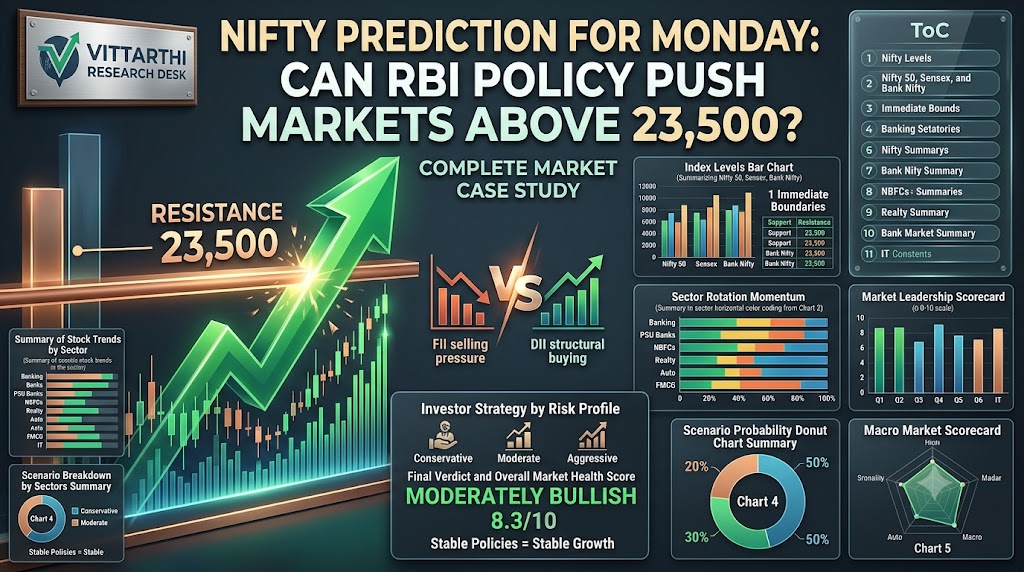
Nifty Prediction for Monday: Can RBI Policy Push Markets Above 23,500?
Platform: Vittarthi Research Desk | Reading Time: 12 Mins
Table of Contents
1. Introduction
The Indian stock market enters the new trading week at a crucial juncture. The Reserve Bank of India's decision to keep the repo rate unchanged at 5.25% has removed one of the biggest uncertainties that investors were tracking over the past few weeks.
However, while the RBI policy outcome may have been largely expected, its implications for Nifty, Sensex, Bank Nifty, sectoral indices, institutional investors, and retail traders remain significant. As markets prepare for Monday's session, traders are asking a simple but important question: Is the market ready for a fresh breakout, or will Nifty remain trapped in a range despite supportive policy signals?
The answer depends on a combination of domestic liquidity, banking sector strength, foreign institutional investor participation, global market cues, crude oil prices, and investor sentiment. This Vittarthi article provides a deep case-study-style analysis of the Indian market heading into the new week, examining the factors that could determine whether Nifty moves above 23,500 or continues consolidating.
2. Understanding Why This RBI Policy Matters
Interest rates influence almost every part of the economy. When rates rise, borrowing becomes expensive, consumer spending slows, home loan EMIs increase, corporate expansion becomes costly, and equity valuations may face pressure. When rates fall, borrowing becomes cheaper, demand rises, economic activity accelerates, and equity markets usually benefit.
This time, the RBI has chosen stability. By maintaining the repo rate at 5.25%, the central bank has effectively communicated confidence in the current economic environment. This signals that policymakers believe inflation is under control, growth remains healthy, credit demand remains robust, and no immediate intervention is required. For stock markets, policy stability is often better than unexpected action.
Often, the RBI's commentary and future outlook matter more than the actual decision itself. A "No Change + Positive Outlook" scenario typically results in broad market strength, which is precisely the environment we find ourselves in today.
Stable policies create compounding wealth. Don't wait on the sidelines.
Calculate Compounding Growth on Vittarthi3. Nifty Analysis: Why 23,500 is the Most Important Level
Psychological levels often play an important role in market behavior. For Nifty, the 23,500 zone currently represents a psychological barrier, a technical resistance area, a sentiment indicator, and a critical breakout trigger.
If Nifty successfully moves above this level and sustains buying interest, market participants may begin anticipating another leg of the rally. However, failure to cross this level could keep the market in consolidation mode.
| Index | Previous Trend | Immediate Resistance | Immediate Support | Outlook |
|---|---|---|---|---|
| Nifty 50 | Positive | 23,500 | 23,300 | Constructive |
*Data extracted from Market Dashboard
The market is currently influenced by three major forces: RBI Policy Stability, robust Domestic Liquidity, and shifting Global Market Sentiment (including US inflation, Fed decisions, and crude oil prices).
4. Sensex Analysis: Tracking the 75,000 Milestone
While Nifty often receives most of the attention, the Sensex remains equally important. The index contains some of India's largest companies and frequently provides confirmation of broader market trends.
Key drivers for the Sensex include robust banking sector participation, rising consumption demand (benefiting from stable inflation and rising disposable incomes), and heavy government infrastructure spending.
Bullish Scenario Levels
- 74,500: Immediate Target
- 74,800: Momentum Zone
- 75,000: Psychological Breakout
- 75,300: Extended Bullish Target
Bearish Scenario Levels
- 74,000: Immediate Support
- 73,800: Strong Support
- 73,500: Critical Support
- 73,200: Weakness Zone
A move above 75,000 would significantly improve sentiment across the broader market.
5. Bank Nifty Analysis: The Market's True Engine
If there is one sector investors should monitor closely, it is banking. Experienced investors understand that Bank Nifty frequently acts as the market's engine. A strong Bank Nifty usually leads to higher Nifty levels, improved investor confidence, and better momentum in midcaps and smallcaps.
The current RBI policy directly benefits banking institutions because lending conditions remain stable, borrowing demand remains healthy, economic activity remains supportive, and asset quality remains manageable.
- Private Banks: Continue showing strength due to strong credit growth, better asset quality, and expanding retail businesses.
- PSU Banks: One of the biggest surprises has been the resurgence of public sector banks, benefiting from lower bad loans, stronger balance sheets, and government support.
Bank Nifty Weekly Technicals
Resistance: 51,500 (Immediate), 52,000 (Major Breakout), 52,500 (Bullish Target), 53,000 (Extended Target).
Support: 51,000 (Immediate), 50,700 (Strong), 50,300 (Critical), 50,000 (Psychological).
6. Sector Rotation Analysis
Historically, every major bull run in India has been driven by a handful of sectors. Sometimes it is banking, sometimes IT, sometimes infrastructure, and occasionally a combination of multiple themes. To understand whether the market can sustain a rally in the coming week, investors must examine sector rotation.
- Realty Sector: A major winner. Because homebuyers depend heavily on financing, stable rates improve affordability, resulting in stable EMIs and better buyer confidence.
- Auto Sector: Quietly benefiting. Stable borrowing conditions help maintain car demand, SUV demand, and two-wheeler sales.
- Consumption & Retail: A stable interest rate environment often boosts consumer confidence, supporting retail spending and lifestyle purchases.
- NBFCs: Non-Banking Financial Companies are highly sensitive to interest rate conditions. Stable rates create predictable borrowing costs and healthy lending demand.
- Aviation & Chemicals: High risk due to rising crude oil prices, which can hurt corporate margins and increase inflation.
7. FII vs DII Analysis: The Ultimate Battle
One of the biggest themes in Indian equities remains the battle between foreign and domestic investors. Earlier, heavy FII selling could trigger major corrections. Today, domestic participation often offsets foreign selling.
Foreign Institutional Investors (FIIs) continue monitoring US interest rates, currency stability, global growth trends, and geopolitical risks. Because of these factors, foreign participation can sometimes become unpredictable.
Domestic Institutional Investors (DIIs) remain supported by a growing mutual fund industry, consistent SIP inflows, and long-term investment horizons. This structural change has significantly improved market resilience.
Stable Repo Rate = Stable Housing Demand. Check your property loan capacity today.
Calculate Home Loan EMI on Vittarthi8. Top Stocks To Watch
If the bullish scenario unfolds, investors may continue watching the following high-momentum stocks across leading sectors:
| Sector | Top Stocks | Outlook |
|---|---|---|
| Banking | HDFC Bank, ICICI Bank, SBI, Axis Bank, Kotak | Bullish / Positive |
| NBFCs | Bajaj Finance, Shriram Finance, Cholamandalam | Bullish / Positive |
| Realty | DLF, Godrej Properties, Lodha, Oberoi Realty | Bullish / Positive |
| Auto | Tata Motors, Maruti Suzuki, M&M, Bajaj Auto | Positive |
| Consumption | Titan, Trent, DMart | Positive |
9. Market Scenarios: Bull, Base, and Bear
Markets rarely move in a straight line. Therefore, instead of predicting a single outcome, professional investors analyze multiple scenarios and assign probabilities to each.
Scenario 1: Bullish Case (Probability: 50%)
The bullish scenario assumes that most favorable factors remain in place. Conditions required: Banking stocks continue leading, Bank Nifty breaks above resistance, domestic liquidity remains strong, FIIs reduce selling, and crude oil does not spike sharply. In this environment, Nifty could target 23,550 to 23,750.
Scenario 2: Base Case (Probability: 35%)
The market remains constructive but lacks enough momentum for a major breakout. The market spends time consolidating before deciding its next major move. Expected trading range for Nifty is 23,300 to 23,500.
Scenario 3: Bearish Case (Probability: 15%)
The bearish scenario currently has the lowest probability but cannot be ignored. Possible triggers include rising crude oil, aggressive FII selling, and weak global markets. Critical support for Nifty sits at 23,000.
10. Investor Strategy by Risk Profile
Not all investors should respond the same way.
- Conservative Investors: Focus on diversification, large-cap stocks, and long-term SIPs. Avoid excessive leverage and short-term speculation.
- Moderate Investors: Focus on Banking, Financial Services, and Quality real estate businesses. Maintain balanced exposure.
- Aggressive Investors: Monitor breakout opportunities, sector rotation, and relative strength. Risk management remains essential.
11. Final Verdict
After analyzing RBI policy, sector performance, Bank Nifty leadership, domestic liquidity, institutional flows, and historical market behavior, the overall market structure remains constructive.
The RBI's decision to maintain the repo rate at 5.25% has provided stability and confidence to investors. Banking stocks remain the strongest area of the market, followed by NBFCs, real estate, and automobile companies. If Bank Nifty sustains strength and Nifty successfully breaks above the 23,500 zone, the market could attempt another leg higher in the coming sessions.
However, investors should continue monitoring crude oil prices, FII activity, and global market developments before becoming overly aggressive. At present, the probability favors a positive-to-range-bound market rather than a sharp correction.
Vittarthi Market Confidence Score: 8.3/10 (Moderately Bullish)
Disclaimer: This article is for educational and informational purposes only. It does not constitute investment advice, stock recommendations, or financial planning guidance. Investors should perform their own research and consult a qualified financial advisor before making investment decisions.
Frequently Asked Questions (FAQs)
Why is Nifty 23,500 such an important level?
For Nifty, the 23,500 zone currently represents a psychological barrier, a technical resistance area, and a key sentiment breakout trigger. If sustained, it could initiate the next leg of the market rally.
How does the unchanged repo rate affect banking stocks?
The RBI maintaining the repo rate at 5.25% ensures that lending conditions remain stable, borrowing demand stays healthy, and asset quality remains manageable. This predictability directly boosts banking profitability and investor confidence.
What is the probability of a market crash next week?
According to the probability matrix case study, a severe bearish scenario currently holds only a 15% probability. Domestic liquidity and banking strength act as strong buffers, though sudden crude oil spikes or aggressive FII selling remain the primary risks.